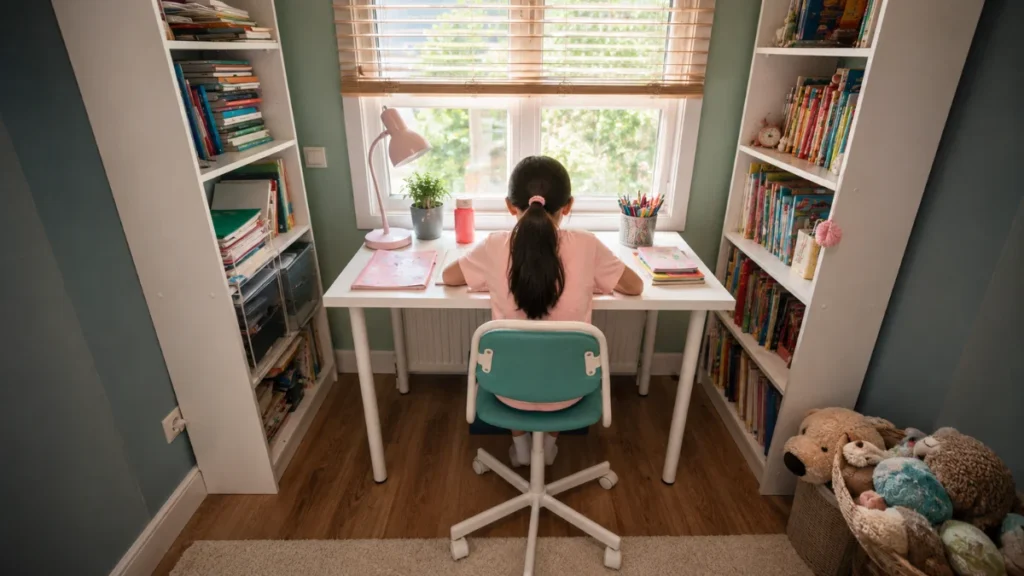
Some children seem calmer when their homework area feels neat, simple, and easy to use. Other children can study almost anywhere, even when the house is noisy or the table is busy. This difference can leave parents wondering why one child seems so affected by their study space while another child barely notices it.
An organized study space can help some children feel calmer because it reduces extra mental work. When children do not have to search for supplies, ignore too many distractions, or process visual clutter, they may have more energy for thinking, focusing, and handling mistakes.
This can feel confusing in real family life because most homes are not quiet learning rooms. Homework may happen at the kitchen table, beside school bags, near siblings, or after a long day when everyone is already tired. A child may look unmotivated, but sometimes their brain is simply trying to manage too much at once.
This article explains why organized study spaces help some children feel calmer, why different children react differently to the same space, and how parents can think about calm learning areas without pressure or perfection.
Real Family Study Space Reality Check
In real homes, study spaces are often shared spaces. The dining table may also be where meals are eaten, bills are sorted, bags are dropped, and siblings talk after school.
Many parents are not working with a spare room, a perfect desk, or a quiet afternoon. They may be helping one child with homework while cooking dinner, answering messages, or looking after younger children.
Children also come home with different levels of energy. Some arrive ready to talk. Some arrive hungry. Some arrive overstimulated. Some have already spent the whole school day trying hard to listen, sit still, remember instructions, and manage friendships.
So when a child struggles to focus at home, the problem is not always the homework itself. Sometimes the environment around the child is adding extra pressure that adults may not notice at first.
What Most Study Space Advice Misses
Many study space tips focus on neat desks, storage boxes, labels, lighting, and routines. These ideas can be helpful, but they can also make parents feel like they need to create a perfect learning setup before their child can succeed.
What this advice often misses is the emotional side of study spaces. A calm study area is not only about where pencils go. It is also about whether the child feels less overwhelmed when learning begins.
For some children, visual clutter feels like background noise for the brain. They may not know how to explain it, but they may feel restless, annoyed, tired, or unable to begin. This is one reason why organized study spaces help some children feel calmer, especially when the child is sensitive to what is happening around them.
Some Children Notice Clutter More Than Others
Children do not all process their surroundings in the same way. One child may sit beside toys, papers, and noise and still finish homework. Another child may find the same space mentally tiring.
This does not mean one child is better at learning. It may simply mean one child’s attention is pulled more easily by the environment.
A cluttered space can quietly ask the brain to keep checking, sorting, and ignoring things. A child may look like they are daydreaming, but their attention may be bouncing between the worksheet, the tablet nearby, the toy on the floor, the noise from another room, and the pencil they cannot find.
This is why the physical space around homework can affect emotional calm. When there is less to manage, some children can settle more easily into the learning task.
Signs a Child May Be Affected by Their Study Environment
Some behaviors that look like avoidance may actually be signs that the study environment feels too busy. This does not mean the child is doing anything wrong. It simply gives parents another way to understand what may be happening.
| What Parents Notice | What May Actually Be Happening |
|---|---|
| Constant fidgeting | The child may be processing too much movement, noise, or visual information. |
| Frequently losing focus | Attention may be split between homework and surrounding distractions. |
| Complaining before starting | The space may already feel mentally heavy before the task begins. |
| Giving up quickly | The child may have less mental energy available for problem-solving. |
| Getting upset over small mistakes | Emotional regulation may already be stretched by the environment. |
| Delaying homework | The child may be avoiding the feeling of sitting in a stressful space. |
If homework often turns tense at home, you may also find How to Make Homework Feel Less Stressful After School helpful, because it looks at the emotional side of homework in busy family life.
What a Child’s Brain Is Processing During Homework
One helpful way to understand this topic is to think of attention as limited energy. A child does not have unlimited focus after a full school day. Their brain has to decide where to place attention.
When the study space is simple, more attention can go toward reading, writing, remembering, and solving problems. When the space is busy, some attention may go toward ignoring sounds, searching for supplies, noticing toys, or watching movement nearby.
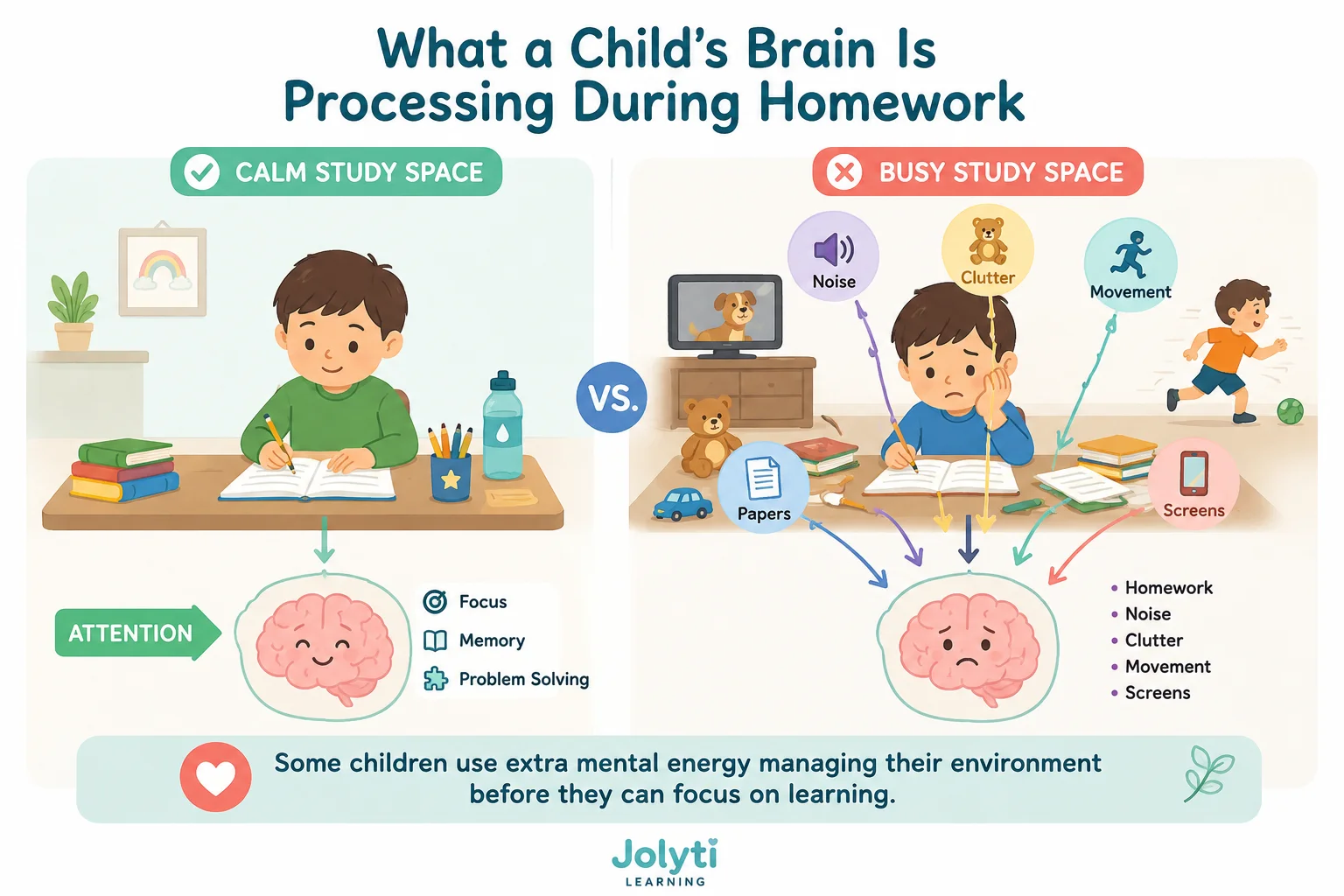
This diagram can show two study spaces side by side. One side shows a simple homework area where attention moves mostly toward learning. The other side shows a busy homework area where attention is divided between homework, noise, toys, screens, papers, and interruptions.
The main message is simple: some children use extra mental energy managing their environment before they can fully focus on learning.
Organized Spaces Can Reduce Decision Fatigue
Another reason organized study areas can feel calming is that they reduce small decisions.
After school, a child may already be tired from making choices all day. They have listened, waited, remembered rules, followed instructions, and moved between activities. When homework begins, a messy space may add more decisions.
Where is my pencil? Which book do I need? Where did I put the worksheet? Should I move these toys? Is this the right page? Do I need to clean first?
Each question may seem small, but together they can make starting feel harder. For some children, the hardest part of homework is not the worksheet. It is the mental effort needed before the worksheet even begins.
A more organized study space can make the beginning feel clearer. The child knows where to sit, where materials are, and what belongs in the space. That predictability can help the brain settle.
This connects naturally with How to Help Children Start Homework Without Delaying, because sometimes children delay not from laziness, but because starting feels too big or unclear.
Calm Spaces Can Support Emotional Regulation
Learning also involves emotions. A child may feel unsure about a math problem, embarrassed about reading aloud, or worried about getting answers wrong.
When the environment is already busy, these feelings can grow faster. A small mistake may feel bigger. A short task may feel longer. A child may become frustrated before they have had enough time to try.
A calm study space does not remove every learning challenge. It does not make homework easy every day. But it can reduce the extra pressure around the task, which may help some children stay calmer for longer.
When learning feels less overwhelming, children often get more chances to experience small successes. Over time, those small successes can quietly strengthen confidence because the child begins to feel, “I can start, I can try, and I can come back again.”
If your child often becomes upset over small errors, How to Help a Child Who Gets Upset After Small Mistakes may help you understand why small mistakes can sometimes feel emotionally big to children.
Organized Does Not Mean Perfect
This is one of the most important parts of this topic. Organized does not mean perfect.
A helpful study space does not need to look expensive, quiet, or picture-ready. It may be a corner of the table, a small desk, a basket of school supplies, or one clear area where homework usually happens.
For many families, the goal is not to create a beautiful study room. The goal is to reduce unnecessary stress. A calm study space is useful because it feels predictable, not because it looks impressive.
Calm Study Space vs Perfect Study Space
Parents can sometimes feel pressure to create the “right” learning space. But children often benefit more from a calm, simple setup than a perfect one.
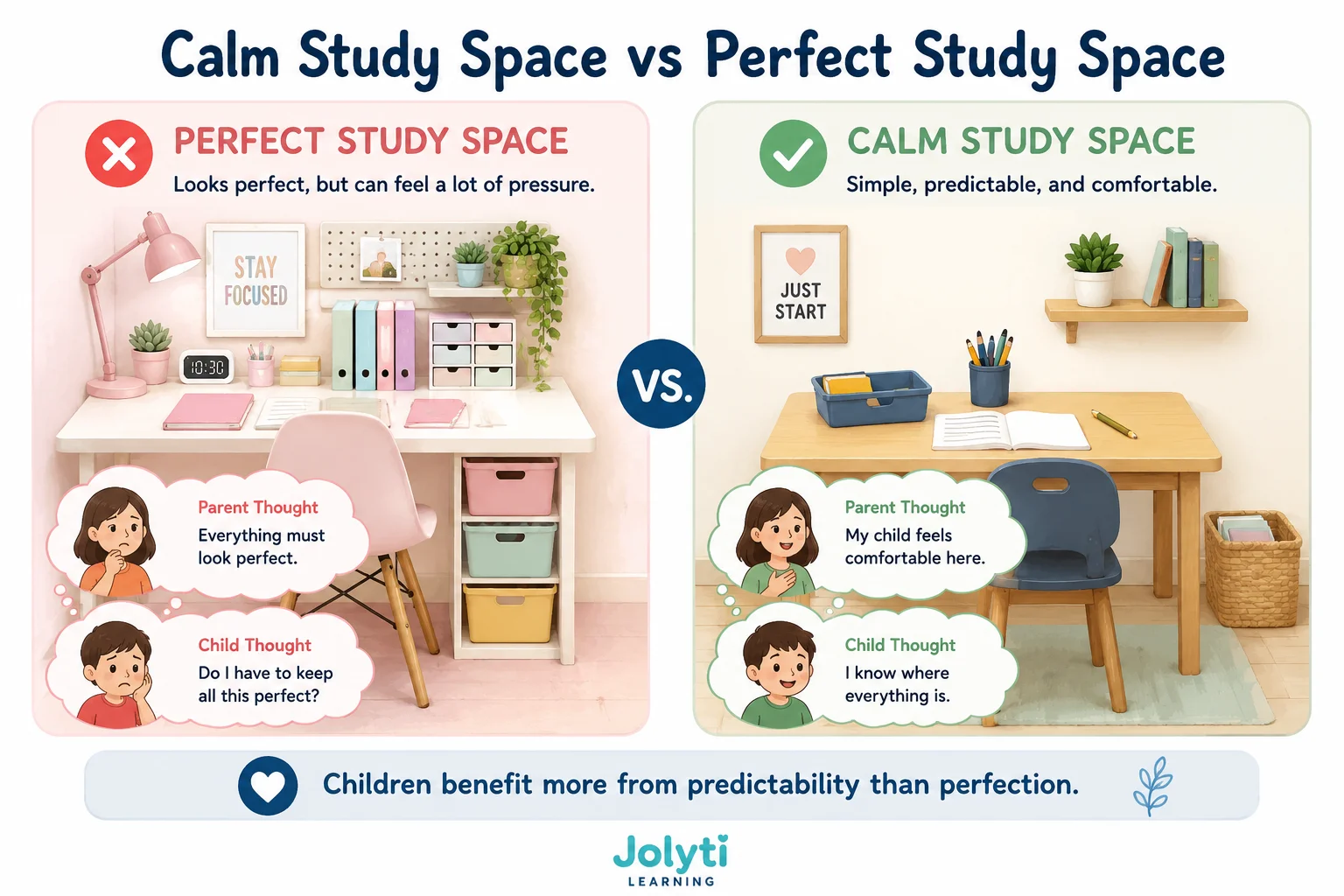
This diagram can compare a perfect-looking study space with a calm study space. The perfect space may show matching storage, a beautiful desk, and a setup that feels hard to maintain. The calm space may show a simple table, a few supplies, and a predictable place where the child feels comfortable.
The message for parents is reassuring: children benefit more from predictability than perfection.
If you want a more practical article about setting up a learning area in a real household, How to Create a Calm Study Space in a Busy Home is a natural next read.
Why Children React Differently to the Same Space
One of the most confusing parts for parents is that siblings can react very differently to the same home environment.
One child may complete homework at the kitchen table while people move around nearby. Another child may feel tense, distracted, or annoyed in that same space.
This can lead parents to wonder why one child is “fine” and the other child is “difficult.” But the difference may not be attitude. It may be how each child processes noise, movement, clutter, and interruption.
Some children need quiet before homework. Some need gentle background sound. Some need a clear surface. Some need movement before they sit. These differences are normal, and they do not mean a child is less capable.
This is similar to the idea explored in Why Some Children Learn Better with Background Noise?, where the best learning environment depends on how the child feels and focuses.
Why Siblings Can React Differently
This visual can help parents understand why the same study space may not feel the same to every child.
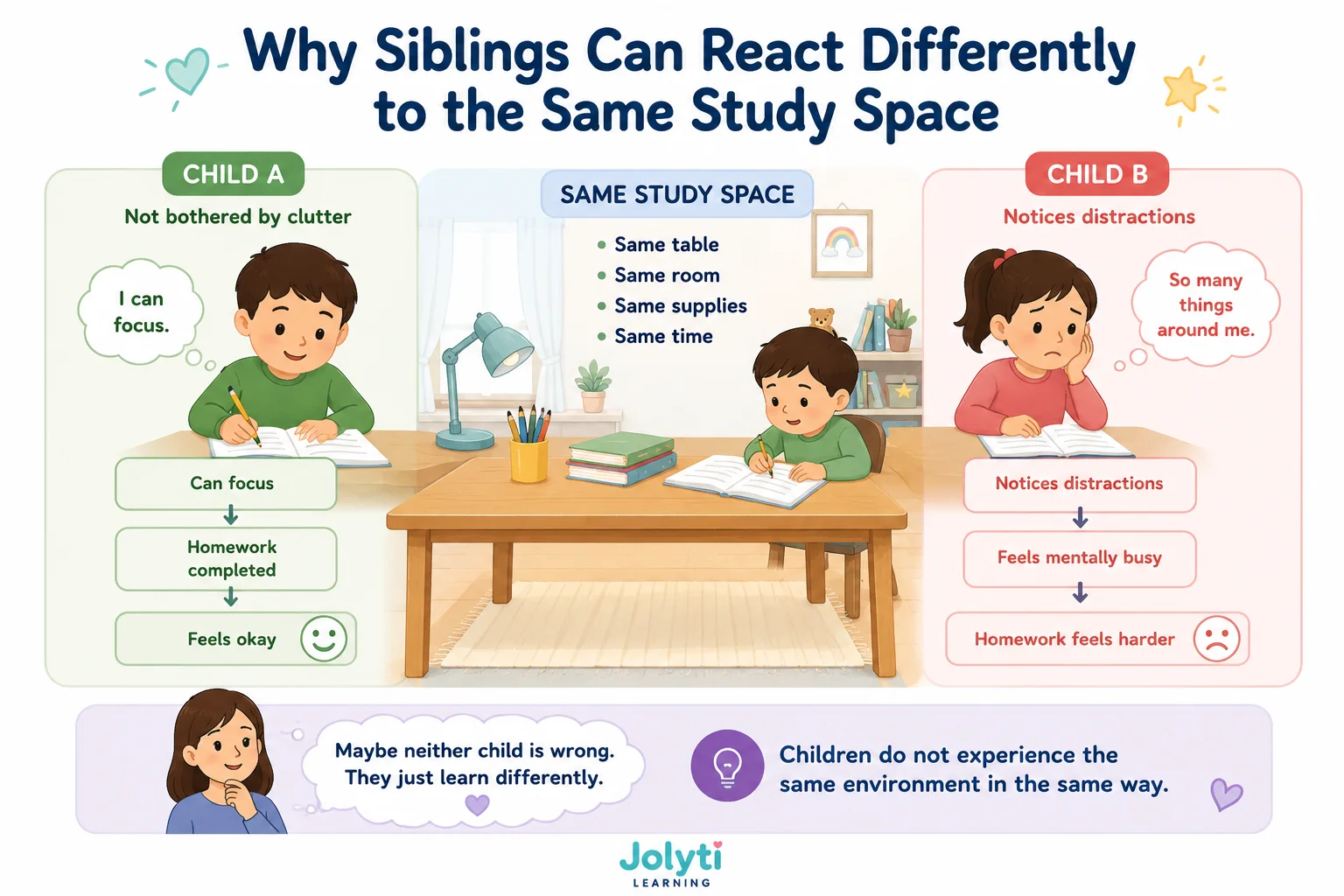
This diagram can show two children using the same study table. One child is not bothered by the surroundings and completes the task. The other child notices every distraction, feels mentally busy, and finds the same homework harder.
The bottom message can say: “Children do not experience the same environment in the same way.”
Practical Insights for Busy Families
There is no perfect study space for every home. Still, some children respond better when the learning area feels simple, predictable, and easy to begin.
- Some children feel calmer when school supplies are kept in one easy-to-find place.
- Many children start more easily when the study surface has fewer visible distractions.
- A familiar homework spot can reduce the stress of deciding where to begin.
- Soft background noise may help some children, while others need quiet.
- A small basket, folder, or pencil case can sometimes make homework feel less scattered.
- It is okay if the space is simple, shared, or imperfect.
These are not strict rules. They are gentle options that families can adjust depending on the child, the home, and the day.
Common Misunderstandings
When children struggle with study spaces, it is easy to misread what is happening. These misunderstandings are common, especially when parents are tired or worried.
- A messy space does not automatically mean a child is lazy.
- A child who needs organization is not weaker than a child who can study anywhere.
- A calm space does not need to be expensive or perfectly decorated.
- Homework resistance is not always a discipline problem.
- Needing fewer distractions does not mean a child cannot learn well.
- Different children may need different study conditions in the same family.
When parents understand the environment more clearly, it can reduce blame. It can also help children feel seen rather than judged.
During Busy School Seasons
Children may become more sensitive to their environment during busy school terms, exam periods, family changes, or weeks with less rest. A space that felt fine last month may suddenly feel too noisy or too crowded.
This does not always mean something has gone wrong. Sometimes the child is carrying more mental load than usual.
During these times, small changes may help. A clearer table, fewer visible distractions, a calmer start, or a short quiet moment before homework can make learning feel less heavy.
If your child seems to need a pause before learning begins, Why Some Children Need Quiet Before Homework Time may help explain why quiet can be a bridge between school energy and home learning.
Jolyti Note: I’ve noticed that some children seem to relax when their learning space feels a little simpler. Not because the space is perfect, but because there is less competing for their attention. Other children hardly notice the difference at all. It reminds me that every child experiences learning environments in their own way.
Frequently Asked Questions
Do organized study spaces help every child?
No. Some children are not strongly affected by clutter or background activity. Others feel calmer when the space is simple and predictable. Children vary in how much their surroundings affect their focus.
Does my child need a separate study room?
No. Many children study well in shared family spaces. A calm study space can be a small table area, a corner of a room, or a clear spot where supplies are easy to find.
Why does my child get distracted even when the room looks clean?
Distraction is not only about mess. Noise, movement, hunger, tiredness, worry, and screen habits can also affect focus. A clean room may help, but it is only one part of the learning environment.
Should I make my child clean before homework?
A small reset may help some children, but cleaning should not become another stressful task before learning. For many families, clearing only the homework area is enough.
What if my child prefers studying with noise?
Some children focus better with gentle background sound. The important difference is whether the noise feels predictable and calming, or distracting and stressful.
Final Thoughts
Why organized study spaces help some children feel calmer is not only about neatness. It is about reducing extra mental work so the child has more energy for learning.
Some children feel calmer when they know where to sit, where their supplies are, and what belongs in the space. Others may need less structure or may learn well with background activity. These differences are normal.
A helpful study space does not need to be perfect. In many homes, a small, predictable, less cluttered area can make learning feel a little lighter. That small feeling of calm can help children begin, stay with the task, and slowly build more confidence at home.
Every child experiences learning spaces differently. Sometimes a few small changes in the environment can make learning feel calmer, lighter, and more manageable for both children and parents.
Featured image is AI-generated and intended for illustrative purposes only.
Leave a Reply