
Hearing a child call themselves dumb can stop a parent in their tracks. It may happen during homework, after a mistake, while reading, or when a child compares themselves with someone else.
When a child calls themselves dumb, they are often expressing frustration, embarrassment, or self-doubt rather than describing their actual ability. Calm responses that help children feel understood can support confidence during difficult learning moments.
This can feel confusing because children do not always explain what is happening inside. A child may say something harsh about themselves, then seem fine a few minutes later. Another child may stay quiet, avoid the task, or act angry instead of saying they feel unsure.
This article looks at what may be happening when a child says “I’m dumb,” how parents can respond calmly, what may be less helpful in the moment, and how small everyday responses can help children rebuild learning confidence over time.
Real Family Learning Reality Check
In real homes, children do not usually say “I’m dumb” during calm, perfect learning moments. They often say it when they are tired after school, hungry before dinner, annoyed by homework, or frustrated because everyone else seems to understand faster.
Parents may also be tired when it happens. There may be dinner to cook, messages to answer, younger siblings nearby, or only a small window of time before bedtime. In that moment, it can be hard to stay calm and choose the perfect words.
This does not mean the parent has failed. It also does not mean the child truly believes they are not smart. Many children use strong words when their feelings are bigger than their ability to explain them.
A child who calls themselves dumb may not need a big confidence speech right away. They may first need a calm moment where someone helps them separate the hard task from who they are.
What Most Parenting Advice Misses
Many parenting tips focus on what exact sentence to say when a child calls themselves dumb. Supportive words can help, but they are only one part of the picture.
What most advice misses is that children often use the word “dumb” as emotional shorthand. One child may mean, “I feel embarrassed.” Another may mean, “This is too hard.” Another may mean, “I think everyone else is better than me.”
This is why one perfect response may not work for every child. Confidence is not built from one script. It grows through repeated experiences where children feel safe enough to struggle, make mistakes, ask for help, and try again.
What “I’m Dumb” May Really Mean
When a child says “I’m dumb,” it can sound like a fact. But very often, it is a feeling dressed up as a fact.
Children are still learning how to name emotions. They may not have the words for disappointment, comparison, shame, frustration, or mental tiredness. So instead of saying, “I feel embarrassed because I got this wrong,” they may say, “I’m dumb.”
This is important because parents may feel tempted to immediately argue with the statement by saying, “No, you’re not.” That response comes from love, but some children may not feel heard if their feeling is skipped too quickly.
A calmer response often starts by noticing the struggle first. The parent is not agreeing that the child is dumb. The parent is showing that the hard feeling makes sense.
What Children Say vs What They May Mean
The table below can help parents look underneath the words. A child’s harsh self-talk often points to a feeling, not a true measure of ability.
| What a Child Says | What They May Really Mean |
|---|---|
| “I’m dumb.” | “This feels hard right now.” |
| “I’ll never get this.” | “I feel frustrated and stuck.” |
| “Everyone is better than me.” | “I am comparing myself with others.” |
| “I’m bad at school.” | “One part of learning feels difficult.” |
| “I give up.” | “I feel overwhelmed and need a softer way back in.” |
This table does not mean every child feels the same thing. It simply reminds parents that the first words children use are not always the full story.
What Happens Inside a Child’s Mind?
A child may call themselves dumb after one difficult question, one spelling mistake, one low result, or one moment where they feel slower than others. The task may be small, but the emotion can feel large.
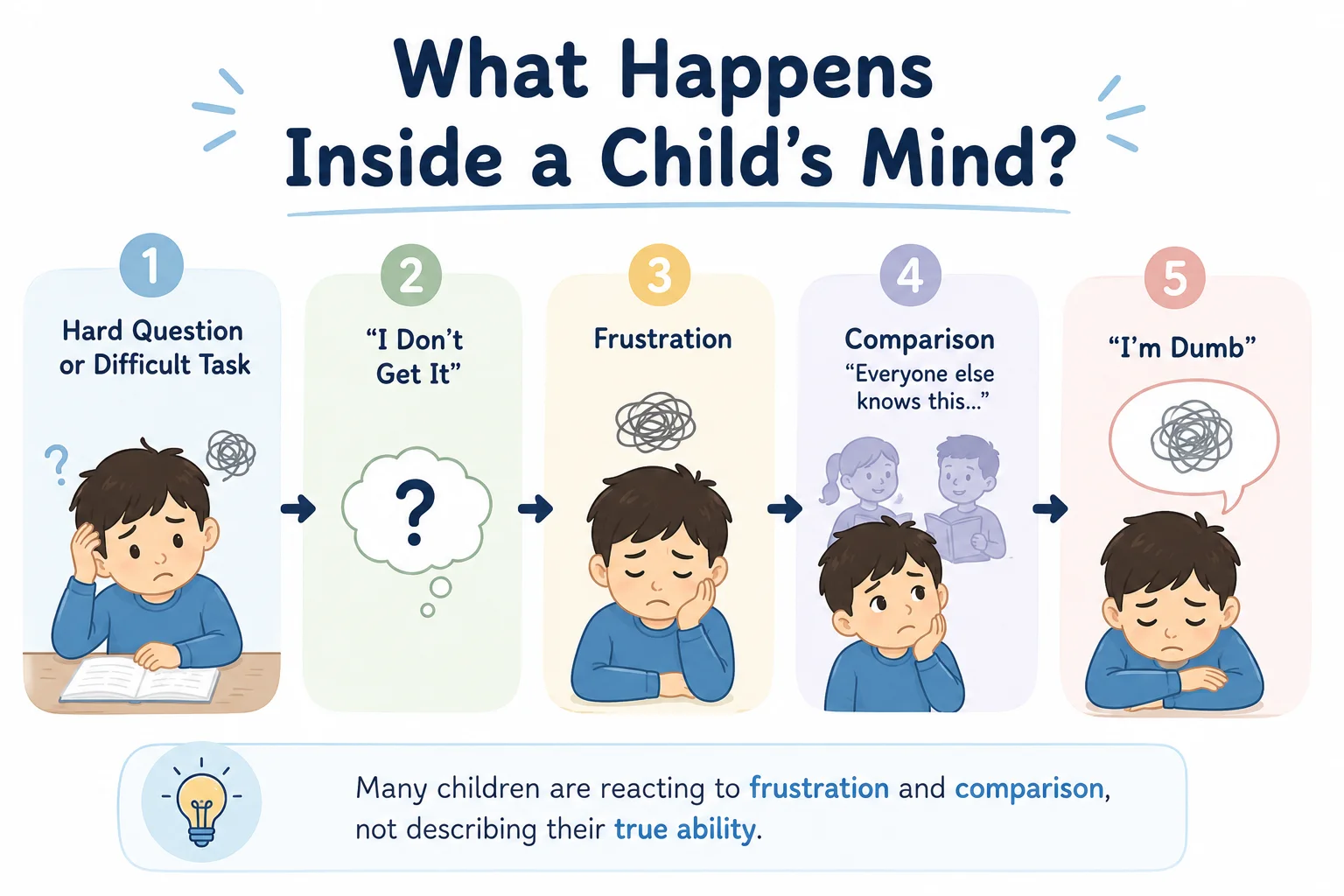
This diagram shows how a difficult task can move through several feelings before a child says “I’m dumb.” It helps parents see that the words are often the final part of an emotional process, not the real starting point.
For children who are already sensitive about mistakes, even a small error can feel personal. This connects naturally with How to Help a Child Who Gets Upset After Small Mistakes, because some children need help recovering emotionally before they can learn from the mistake.
What to Say in the Moment
Parents do not need to say something perfect. A calm, simple response is usually more helpful than a long speech.
When a child calls themselves dumb, some gentle responses may include:
- “That sounds really frustrating.”
- “This feels hard right now.”
- “One hard question does not tell us who you are.”
- “You are stuck, not dumb.”
- “Let’s slow this down a little.”
- “Your brain is still learning this.”
These responses help separate the child’s identity from the learning moment. They also keep the emotional temperature lower, which can make it easier for the child to try again later.
Some children may not want encouragement immediately. They may need a short pause, water, movement, or a quieter moment before they are ready to hear anything. That is not failure. It is often how children reset.
What Not to Say Immediately
Most parents respond quickly because they care. When a child says “I’m dumb,” it is natural to want to stop those words right away. But some quick responses can accidentally make the child feel unheard, even when the parent means well.
Responses that may feel less helpful in the first moment include:
- “Don’t be silly.”
- “Stop saying that.”
- “Of course you’re not dumb.”
- “You just need to try harder.”
- “This is easy.”
These words often come from love, not blame. The problem is that a discouraged child may hear them as, “My feeling does not make sense.” In many homes, it works better to notice the feeling first, then gently guide the child back toward confidence.
For example, instead of only saying, “You’re not dumb,” a parent might say, “This feels really hard right now. One hard moment does not mean you are dumb.” That small change keeps the reassurance while also making space for the child’s frustration.
Confidence Garden
Children’s confidence is shaped by many small experiences. It can shrink when learning feels unsafe, rushed, or full of comparison. It can grow when children feel understood and able to try without being judged.
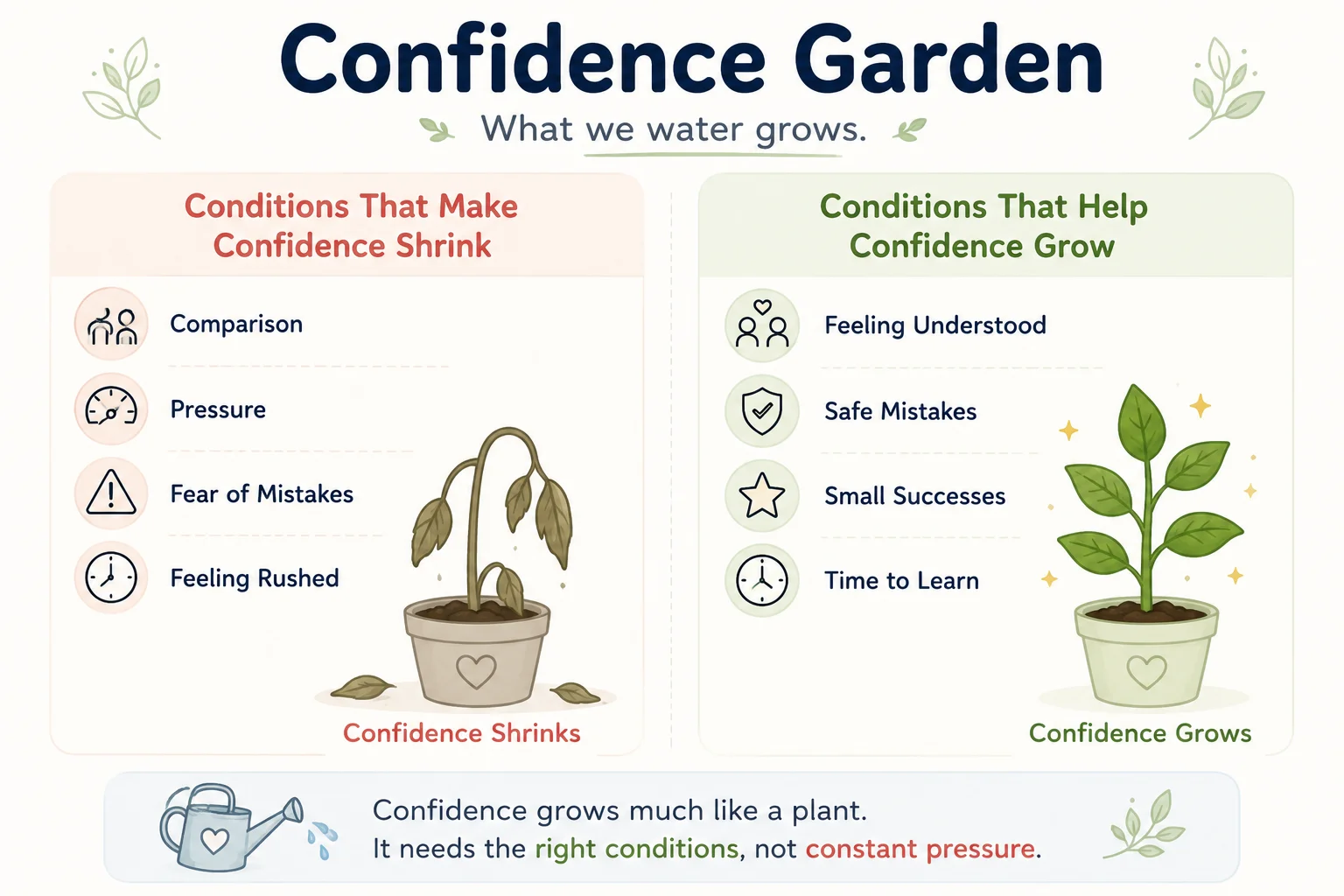
This Confidence Garden diagram compares two learning conditions. On one side, comparison, pressure, fear of mistakes, and feeling rushed can make confidence shrink. On the other side, feeling understood, safe mistakes, small successes, and time to learn can help confidence grow.
If your child often seems unsure even when they are capable, Why Quiet Children Sometimes Doubt Their Learning Ability may help explain how self-doubt can appear quietly, not only through big emotional reactions.
Different Children Show Self-Doubt Differently
Some children say “I’m dumb” loudly and quickly. Their frustration comes out in words, tears, anger, or refusal. Other children may never say those words, but they may hide their work, avoid hard tasks, or stay silent when they do not understand.
This is why parents may need to look at patterns, not just one sentence. A child who avoids answering may be just as worried as a child who says something negative out loud.
Some children become discouraged when they compare themselves with classmates. Some lose confidence when they see a sibling finish faster. Some feel embarrassed when parents try to help because they think needing help means they are not smart.
These reactions are not signs of bad character. They are signs that learning and emotion are connected. This is also why Signs a Child Is Afraid of Getting Answers Wrong may be helpful for parents who notice worry, avoidance, or fear around mistakes.
Two Possible Paths After a Mistake
A supportive response does not magically remove self-doubt. But it can change what happens next. Instead of the child feeling alone with the hard feeling, they may feel understood enough to stay connected.
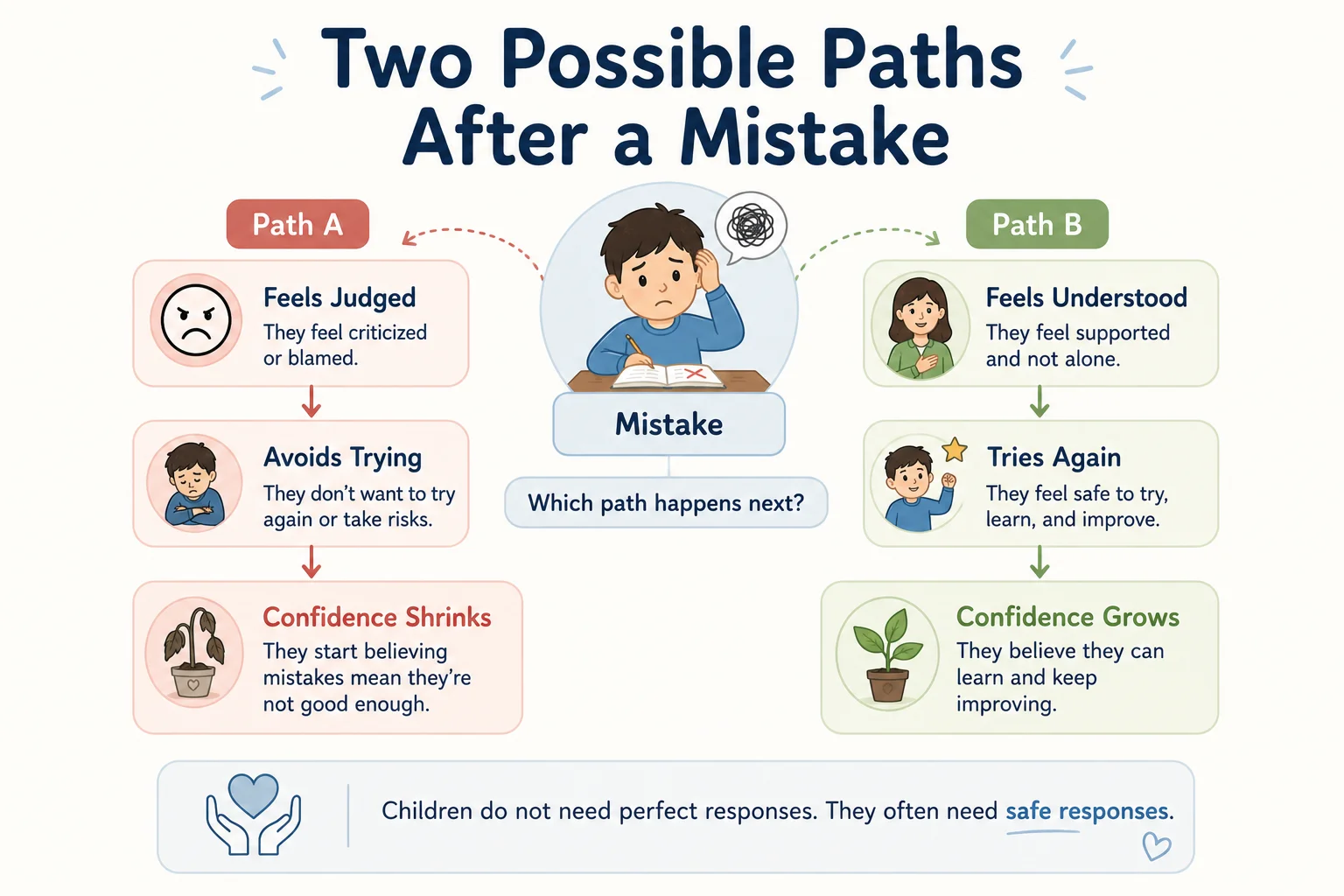
This diagram shows two possible paths after a mistake. When a child feels judged, they may avoid trying and their confidence may shrink. When a child feels understood, they may feel safer to try again and keep improving.
This matters because confidence often grows through safety before skill. A child who feels emotionally safe is usually more able to think, ask, practise, and return to the task.
Practical Insights That Can Help
There is no perfect sentence that works for every child. Still, many children respond better when parents keep the moment calm and help the child feel less defined by the mistake.
- Notice the feeling before trying to fix the work.
- Use calm words that separate the child from the task.
- Keep the next step small enough to feel possible.
- Avoid comparing the child with siblings or classmates.
- Notice effort, starting again, and asking for help.
- Let confidence grow gradually instead of forcing it quickly.
These are not strict parenting rules. They are gentle options families can adjust depending on the child, the task, and the mood of the home that day.
If your child often feels behind or not good enough, How to Encourage a Child Who Thinks They Are Behind may offer extra support for those comparison-heavy moments.
Common Misunderstandings
When children call themselves dumb, it is easy for parents to feel worried. But some common misunderstandings can make the moment feel heavier than it needs to be.
- Struggling with one task does not mean a child is struggling with everything.
- Confidence is not the same as intelligence.
- A child can be smart and still feel unsure.
- Slow progress does not mean the child cannot learn.
- Emotional reactions are not the same as laziness.
- School performance should not become a child’s whole identity.
When parents see these differences more clearly, the child’s words can feel less frightening and more understandable.
During Busy Family and School Weeks
Negative self-talk may become stronger during busy school terms, assessment weeks, tired evenings, or after long days with too much noise and pressure.
A child who usually manages homework calmly may suddenly say harsh things about themselves when they are low on energy. This does not always mean their confidence has disappeared. It may mean the child’s emotional energy is temporarily stretched.
During these times, a smaller task may be more helpful than pushing through a full learning session. One question, one page, or one short retry can sometimes keep learning moving without adding more pressure.
For families where homework often becomes tense, How to Stop Homework from Turning into Arguments may also be useful because emotional safety can make learning at home feel less like a battle.
Jolyti Note: I’ve noticed that children often say the strongest words about themselves when they are already tired or discouraged. Sometimes the words sound bigger than the real problem in front of them. Every child responds differently, but many seem to soften when the adult first understands the feeling instead of rushing straight to correction.
Frequently Asked Questions
Should I tell my child not to say they are dumb?
It is understandable to want to stop those words quickly. But many children respond better when the feeling is noticed first. A calm response such as “That sounds frustrating” can make the child feel heard before you gently separate the mistake from who they are.
Does saying “I’m dumb” mean my child has low self-esteem?
Not always. Sometimes it is a temporary reaction to frustration, tiredness, or embarrassment. If it happens often across many situations, it may be worth paying closer attention to patterns and giving the child more emotional support around learning.
What if my child refuses to try after saying it?
Refusing to try may mean the child feels overwhelmed. A short pause, smaller task, or easier starting point may help. Some children need to calm down before they can think clearly again.
Why does my child say this only during homework?
Homework often happens when children are already tired from school. It also happens at home, where emotions may come out more strongly. The child may feel safe enough to express frustration at home, even if they hide it at school.
Can confidence improve if my child still doubts themselves sometimes?
Yes. Confidence does not mean a child never feels unsure. Many children still have self-doubt while slowly becoming more willing to try, ask for help, and recover from mistakes.
Final Thoughts
When a child calls themselves dumb, it can feel painful for a parent to hear. The words may sound like a deep belief, but often they are a sign of frustration, embarrassment, comparison, or tiredness.
Parents do not need a perfect script. A calm response that helps the child feel understood can make the moment less heavy. Over time, these small responses can help children learn that hard tasks do not define who they are.
Confidence usually grows slowly in real homes. It grows through safe mistakes, small retries, gentle encouragement, and repeated reminders that one difficult moment is not the whole story of a child’s learning ability.
Featured image is AI-generated and intended for illustrative purposes only.
Leave a Reply