
Many parents have heard a child say something like, “I’m behind,” “Everyone else is better than me,” or “I’m not good at this.” These words can feel heavy because they often come from a place of worry, embarrassment, or quiet self-doubt.
How to encourage a child who thinks they are behind often starts with helping them feel safe, understood, and capable again. Many children need calm reassurance, smaller learning steps, and visible signs of progress before they can believe they are catching up.
This can be difficult for parents because the child may not only be struggling with schoolwork. They may also be struggling with comparison, fear of mistakes, tiredness, or the feeling that everyone else is moving faster.
This article will explain how to encourage a child who thinks they are behind in a calm, realistic, and confidence-building way. The goal is not to push children harder, but to help them feel steady enough to keep trying.
Why Feeling Behind Can Feel Bigger at Home
In real family life, learning does not happen in a quiet, perfect space every day. A child may come home tired, hungry, annoyed, overstimulated, or already worried about something that happened at school.
Parents may also be tired. Dinner may need to be made. Siblings may interrupt. There may be homework, messages from school, housework, and other responsibilities all happening at once.
So when a child says they are behind, the moment can feel emotional for everyone. Parents may want to help quickly, while the child may already feel judged, even if no one is blaming them.
This is why encouragement needs to feel calm before it feels practical. A child who thinks they are behind may not be ready to hear a plan until they first feel understood.
What Most Advice About Falling Behind Misses
Common advice often sounds simple: study more, practice harder, pay more attention, or catch up quickly. These ideas may sometimes help, but they do not always reach the deeper problem.
Many children who think they are behind are not only struggling with the subject. They are also struggling with the feeling of being left out, slower, less smart, or not good enough.
If the child already feels discouraged, extra pressure can sometimes make learning feel even more unsafe. They may avoid homework, hide schoolwork, or stop trying because trying feels like another chance to fail.
If this sounds familiar, you may also find Why Some Children Hide Their School Work from Parents helpful.
Why Children Start Feeling Behind
Children can start feeling behind for many reasons. Sometimes they compare themselves with classmates. Sometimes one difficult subject makes them believe they are behind in everything. Sometimes they hear other children answer quickly and assume they are the only one struggling.
For some children, one hard school week can become a bigger story in their mind: “I am bad at this.” That story can grow even when adults can still see progress.
Helping a child who feels behind often begins by noticing what may be underneath the words. The child may be saying “I am behind,” but they may really mean “I feel scared,” “I feel embarrassed,” or “I do not know how to catch up.”
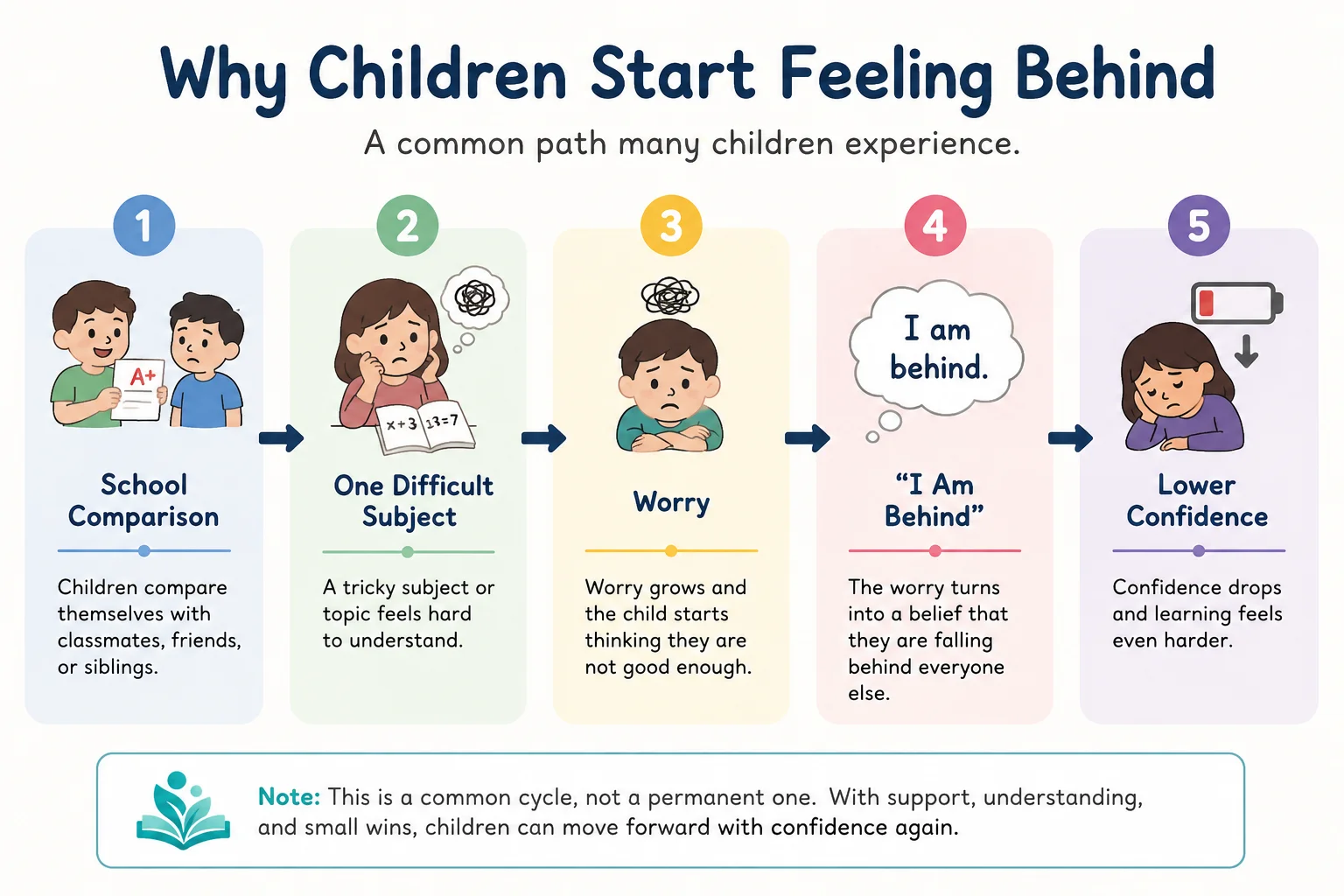
This kind of visual can help parents see that feeling behind is often emotional as well as academic. The child may need support with confidence, not just more practice.
Help Them See Learning Is Not a Race
Children often notice who finishes first, who gets the highest score, or who seems to understand quickly. Because of this, learning can start to feel like a race.
But children grow in uneven ways. A child may read well but struggle with maths. Another may be slow to start but strong once they understand. Another may need more repetition before things feel clear.
One helpful way to encourage a child who thinks they are behind is to gently move their attention from other people’s progress to their own progress.
You might ask:
- What feels a little easier than before?
- What did you understand today that was confusing last week?
- What part are you still learning?
- What is one thing you kept trying even when it felt hard?
These questions do not ignore the struggle. They simply help the child see that learning is not only about where they are today. It is also about where they are moving.
Make Progress Easier to See
Children who feel behind often cannot see their own improvement clearly. They may focus only on what they still cannot do.
Parents may notice growth that the child misses. For example, a child may still make spelling mistakes, but now writes longer sentences. A child may still need help with maths, but now understands the first few steps better than before.
Small progress can be easy to overlook when everyone is focused on catching up.
One gentle idea is to keep progress visible in a simple way. This does not need to be a big chart or reward system. It can be as simple as writing down one thing the child learned each week.
| Instead of Only Noticing | Also Notice |
|---|---|
| The final score | What the child understands better now |
| How fast the child finishes | How much longer they can stay with a task |
| Every mistake | The mistakes they corrected calmly |
| What classmates can do | The child’s own small improvements |
| How much is still unfinished | The next step that feels possible |
When children see proof of progress, confidence has something real to stand on.
What Encouragement Can Sound Like
When a child thinks they are behind, the words adults use can make a big difference. Some phrases are meant to help, but may accidentally make the child feel more alone.
For example, “Just work harder” may sound simple to an adult, but to a discouraged child it may feel like, “You are not doing enough.”
Encouraging words work better when they show understanding and give the child a small way forward.
| Less Helpful | More Helpful |
|---|---|
| “You just need to work harder.” | “Let’s take this one step at a time.” |
| “Everyone struggles.” | “I can see this feels difficult right now.” |
| “You should know this already.” | “You are still learning this.” |
| “Stop saying you can’t.” | “It feels hard now, but we can start small.” |
| “Your brother understood this quickly.” | “Your learning path does not have to look the same.” |
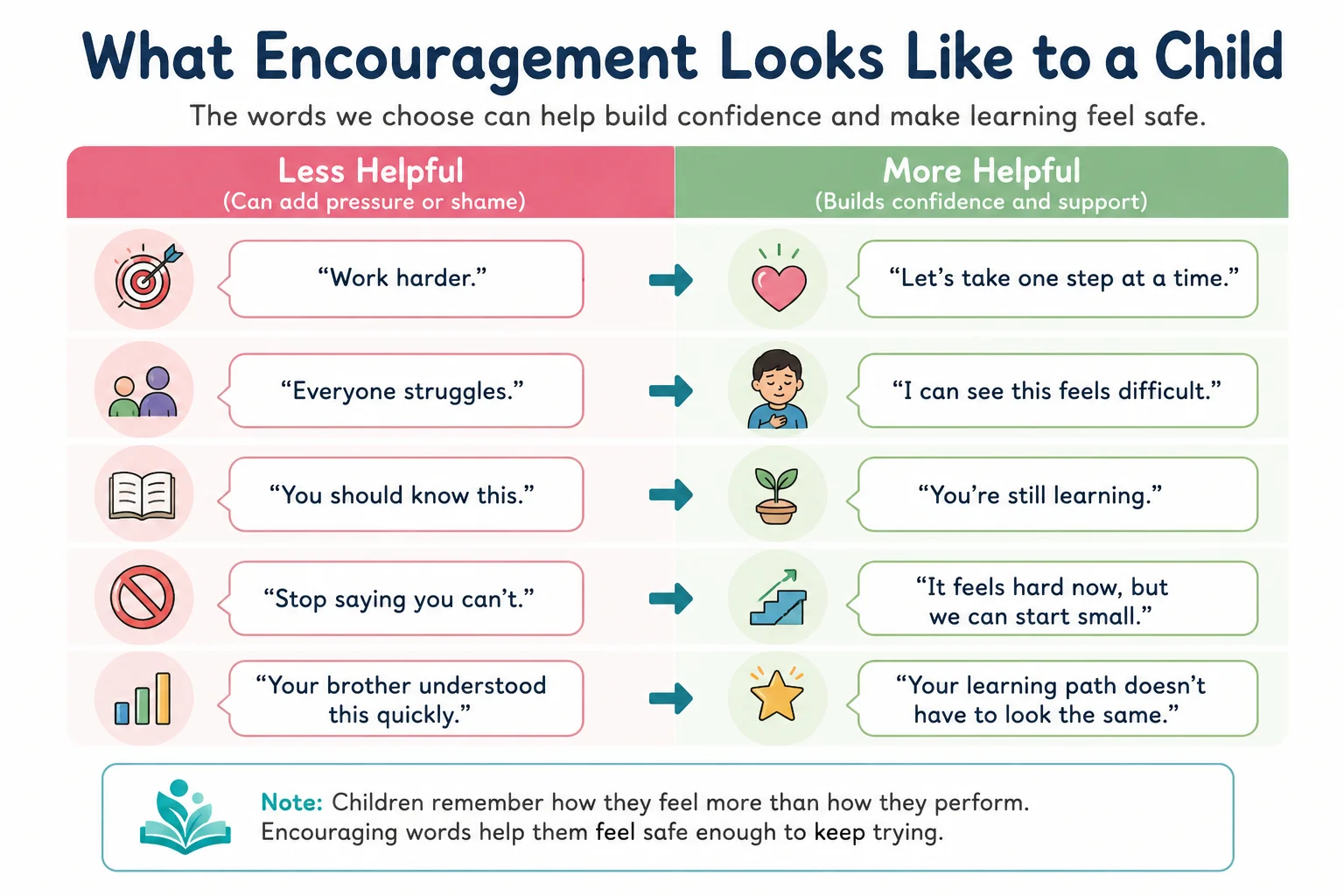
This visual can help parents choose phrases that reduce pressure while still supporting progress.
Focus on the Next Small Step
When children think they are behind, they may feel overwhelmed by the whole subject. The gap feels too big, so they may not know where to start.
In that moment, the next small step matters more than the full journey.
Instead of trying to fix everything at once, parents can help the child find one small action that feels possible.
- Read one page instead of the whole chapter.
- Try three maths questions instead of twenty.
- Practice one spelling pattern instead of the whole list.
- Write the first sentence instead of the whole paragraph.
- Review one mistake calmly instead of redoing the whole task.
Small steps help children experience success again. That success may feel small to adults, but to a discouraged child, it can be the beginning of hope.
If long learning sessions often feel too much for your child, Why Short Study Sessions Work Better for Some Children connects closely with this topic.
How Confidence Usually Rebuilds
Confidence does not usually return because someone gives one perfect speech. It often rebuilds through repeated small experiences that show the child they can still learn.
A child may begin by feeling behind. Then they complete one small task. That small success makes them a little more willing to try again. More practice becomes possible. Over time, confidence slowly grows.
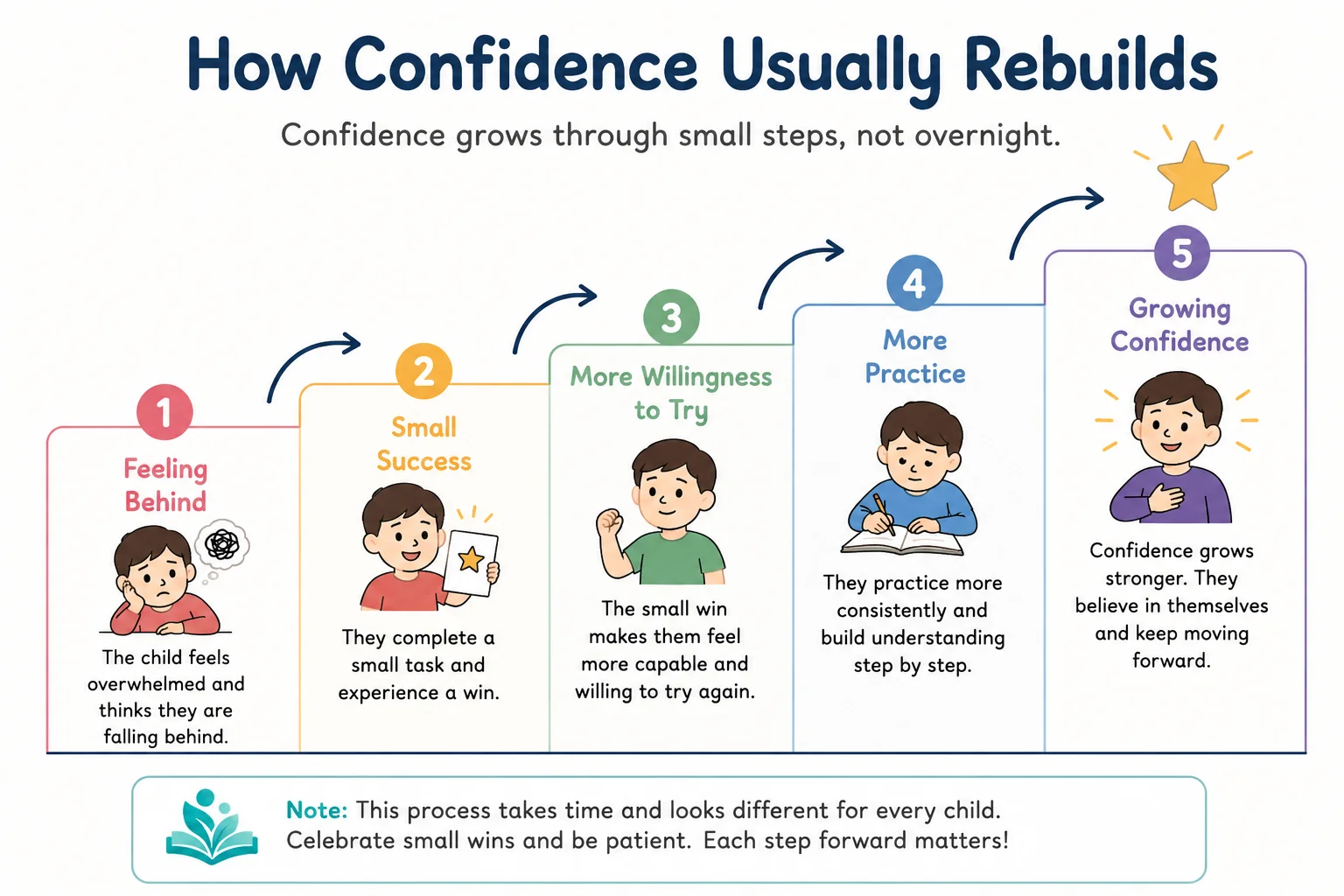
This is why small wins matter. They give children real evidence that they are not stuck forever.
For a related confidence-building approach, you may also find How to Build Learning Confidence Without Rewards helpful.
Practical Ideas for Busy Families
Encouraging a child who thinks they are behind does not need to become a big family project. Small, calm actions can support confidence over time.
- Start with listening before giving advice.
- Use shorter learning sessions when emotions are high.
- Point out one small improvement each week.
- Help your child compare today’s effort with their own past effort.
- Let them redo one small part instead of repeating everything.
- Give them time to explain what feels hard.
- Use calm phrases that separate the child from the struggle.
- Remind them that needing more time does not mean they cannot learn.
These ideas are not strict rules. They are gentle ways to make learning feel safer and more possible.
Common Mistakes That Can Weaken Confidence
Most parents do some of these things at times, especially when they are tired or worried. This is not about guilt. It is simply helpful to notice what may make a child feel more behind.
- Comparing the child with siblings or classmates.
- Talking more about grades than progress.
- Correcting every mistake immediately.
- Turning every homework moment into a performance test.
- Assuming the child is not trying because they avoid the task.
- Expecting confidence to return quickly.
Sometimes children need space to rebuild trust in themselves before they can show stronger learning behavior.
Different Children Show Feeling Behind Differently
Not every child says, “I feel behind” clearly. Some children become quiet. Some get angry. Some joke around. Some avoid homework. Some say they do not care, even when they care deeply.
A quiet child may compare themselves silently. An energetic child may act distracted because sitting with the struggle feels uncomfortable. A sensitive child may cry quickly because each mistake feels personal. An independent child may refuse help because needing help feels embarrassing.
This is why encouragement works best when it matches the child in front of you. Some children need words. Some need space. Some need help starting. Some need reassurance that mistakes will not change how adults see them.
Children who feel behind are not all asking for the same kind of support. But many are asking, in their own way, to feel capable again.
Family and Seasonal Context
Children may feel more behind during busy parts of the school year. Assessment weeks, school-term tiredness, holiday routine changes, illness, family stress, or moving between year levels can all affect confidence.
Sometimes the child is not truly falling far behind. They may simply be tired, overwhelmed, or comparing themselves more than usual.
During these times, calm support can matter as much as academic practice. Children often learn better when they feel steady enough to try.
Jolyti Note: I’ve noticed that some children become more open to learning when they stop feeling measured against everyone else. Sometimes confidence grows quietly when a child begins to see one small piece of progress that belongs to them.
Frequently Asked Questions
How do I encourage a child who thinks they are behind?
Start by helping the child feel understood before trying to fix the problem. Then focus on one small next step, notice progress, and avoid comparing them with other children.
What should I say when my child says everyone else is smarter?
You can calmly say, “It sounds like you feel discouraged right now. Let’s look at what you are learning step by step.” This validates the feeling without agreeing with the comparison.
Why does my child feel behind even when they are doing okay?
Some children focus more on mistakes than progress. Others compare themselves with classmates or siblings. A child can be making progress and still feel unsure inside.
Should I push my child harder if they are behind?
More pressure is not always the best first step. Some children need smaller tasks, calmer support, and repeated small wins before they can handle more challenge confidently.
How long does it take to rebuild learning confidence?
There is no fixed timeline. Confidence often grows through many small positive learning experiences. The goal is steady progress, not a sudden change overnight.
Final Thoughts
Learning how to encourage a child who thinks they are behind is not only about helping them catch up academically. It is also about helping them feel safe enough to keep learning.
A child who feels behind may need reassurance, smaller steps, and gentle proof that progress is still happening. They may need help seeing that learning is not a race and that needing more time does not mean they are failing.
Parents do not need perfect words or perfect routines. In many homes, confidence grows through small calm moments, patient support, and repeated chances to try again. Over time, those moments can help a child believe, “I am still learning, and I can keep going.”
Featured image is AI-generated and intended for illustrative purposes only.
Leave a Reply