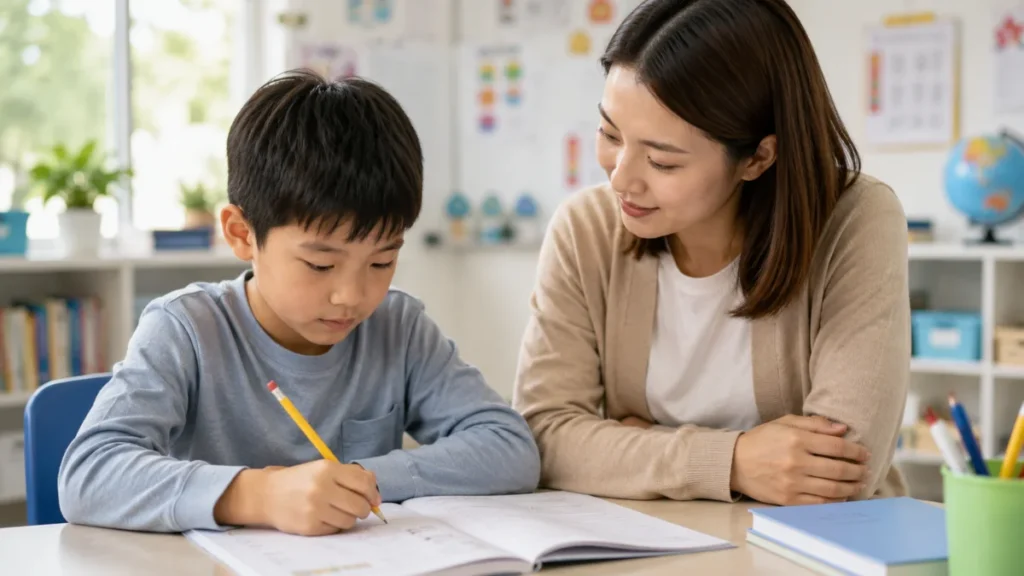
Many parents start noticing signs a child is afraid of getting answers wrong during homework, reading practice, spelling, maths questions, or simple learning conversations at home. A child may pause for a long time, whisper an answer, say “I don’t know” too quickly, or become upset after one small mistake. This can feel confusing, especially when the child seems to understand more than they are willing to say.
Signs a child is afraid of getting answers wrong often include hesitation, avoiding answers, constantly checking work, asking for reassurance, becoming upset by small mistakes, refusing to guess, or staying unusually quiet during learning. In many cases, the child is not refusing to learn. They may be trying to protect themselves from the uncomfortable feeling of being wrong.
This worry can be hard for parents to understand because children do not all show fear in the same way. Some children cry or get frustrated. Others shut down quietly. Some still get good marks at school but become nervous when asked questions at home. This does not mean the child is lazy, difficult, or lacking ability.
Many children need time to feel safe enough to try, guess, and make mistakes without feeling judged. This article looks at the emotional signs, quiet signs, and everyday learning behaviours that may show a child is afraid of getting answers wrong, especially in real family life where learning does not always happen calmly or perfectly.
Real Family Learning Reality Check
In real homes, learning often happens after a long school day, not inside a calm classroom with perfect timing. Homework may happen while dinner is cooking, siblings are talking, parents are tired, devices are nearby, and everyone is trying to get through the evening.
A child who fears getting answers wrong may seem more nervous at home because home is emotionally different from school. At school, routines are predictable and the child may know what is expected. At home, learning can feel more personal. A mistake in front of a parent may feel bigger than a mistake in a workbook at school.
This does not mean parents are doing anything wrong. It simply means children can carry different emotions into different places. A child may feel safe at home but still worry about disappointing someone they love. That emotional mix can make simple learning tasks feel heavier than expected.
Different siblings can also respond very differently. One child may answer quickly without worrying. Another may need more time because the thought of being wrong feels uncomfortable. Both children may be capable learners, but their confidence may grow in different ways.
What Most Parenting Advice Misses
Many parenting tips focus on what children should do: try harder, keep practising, be brave, or learn from mistakes. These ideas can be helpful, but they sometimes miss the emotional part of learning.
For some children, being wrong does not feel like a normal part of learning yet. It feels embarrassing, disappointing, or unsafe. A child may understand that mistakes are allowed, but still feel worried when a real mistake happens.
This is why fear of getting answers wrong cannot always be solved by telling a child, “Just try.” Some children need the learning environment to feel softer before they can take learning risks. Confidence often grows slowly through repeated moments where a child discovers that being wrong does not change how they are seen.
What May Be Happening Beneath the Surface
When a child hesitates, avoids answering, or says “I don’t know,” the visible behaviour may only be the final part of a longer emotional process. The child may first feel unsure, then imagine being wrong, then worry about the reaction, and only then avoid answering.
This is why the same behaviour can mean different things in different children. One child may avoid answering because they truly do not understand. Another may avoid answering because they understand enough to try, but not enough to feel safe.
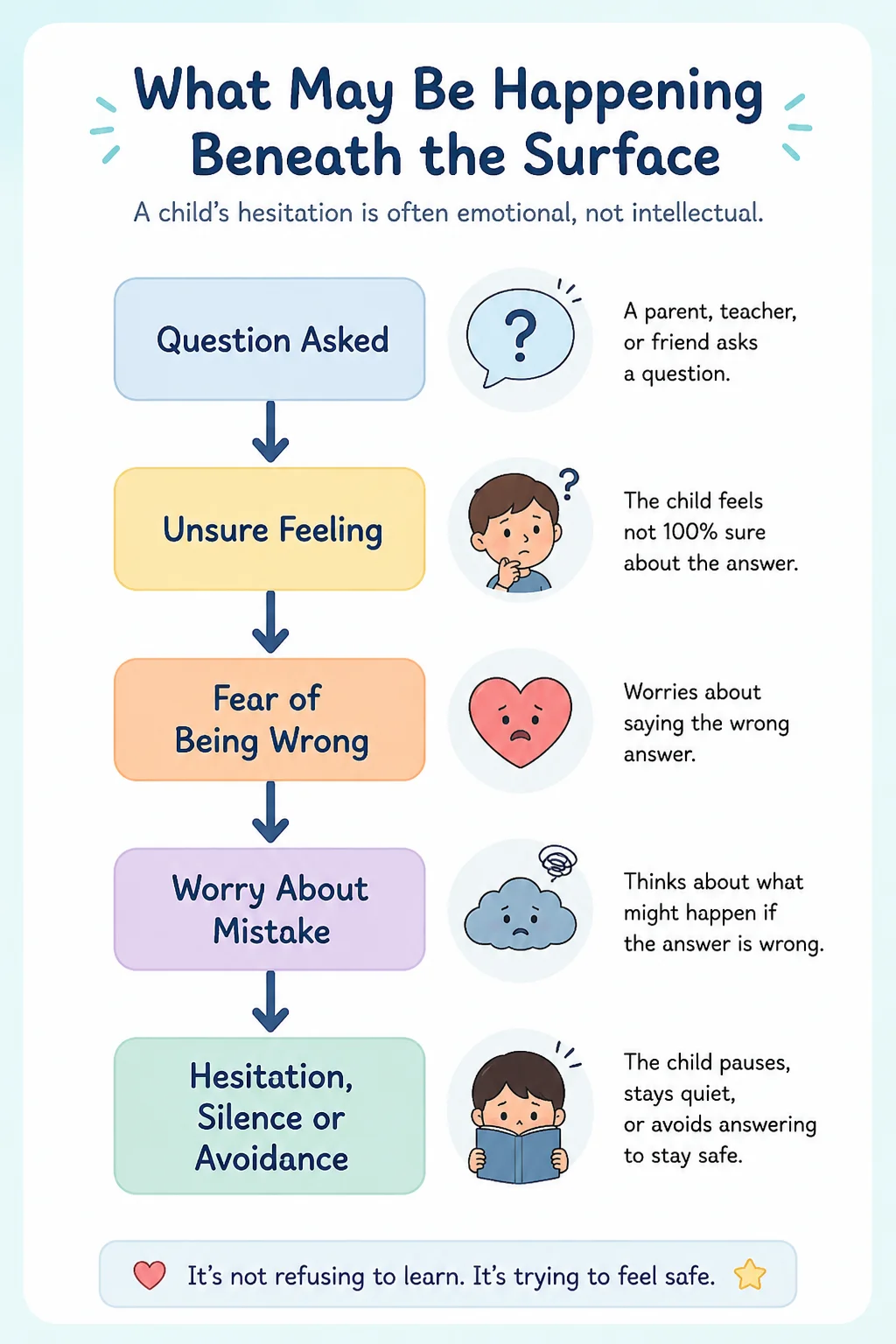
A simple emotional learning diagram can help parents see that hesitation is not always stubbornness. Sometimes it is the child’s way of slowing down because the answer feels emotionally risky.
Hesitation Before Giving an Answer
One of the most common signs a child is afraid of getting answers wrong is hesitation. A parent may ask a simple question, but the child pauses for a long time before responding. They may look at the parent’s face, wait for a clue, or speak so quietly that the answer is almost hidden.
This hesitation can be mistaken for not knowing. Sometimes that is true, but not always. Some children pause because they are checking whether it is safe to try. They may be thinking about the answer and the possible reaction at the same time.
In busy households, this can be easy to miss. A parent may be trying to help quickly, especially when time is short. But for a child who fears being wrong, rushed learning can make the pause even longer because the emotional pressure feels stronger.
Constantly Checking Their Work
Another sign a child may be afraid of wrong answers is constantly checking their work. They may erase answers again and again, reread the same instruction many times, or ask someone to check even simple tasks before they move on.
Carefulness is not a problem by itself. Many children like to do good work. But when checking becomes stressful, repeated, or emotionally tense, it may show that the child is uncomfortable with uncertainty.
The child may not be looking for learning help every time. They may be looking for emotional safety. They want someone else to confirm that the answer is safe before they fully trust it.
Becoming Upset by Small Mistakes
Some children become deeply upset by mistakes that look small to adults. A wrong spelling word, one incorrect maths answer, or a crossed-out sentence may lead to tears, anger, silence, or giving up.
This does not always mean the child is overreacting on purpose. The mistake may feel much larger inside the child’s mind than it looks on paper. For some children, a wrong answer feels like proof that they are not smart, even when that is not true.
This connects closely with learning confidence. If your child often becomes upset after small errors, you may also find How to Help a Child Who Gets Upset After Small Mistakes helpful, because small mistakes can sometimes carry big emotions for children.
Avoiding Participation When Unsure
Children who are afraid of getting answers wrong may avoid participation when they are unsure. At school, they may stop raising their hand. At home, they may avoid educational games, reading aloud, or answering practice questions.
Some children quickly say “I don’t know” even when they might know part of the answer. This can be frustrating for parents because it seems like the child is not trying. But sometimes “I don’t know” is a protective answer. It allows the child to escape the risk of being wrong.
Avoidance can also become a habit because it brings short-term relief. When the child avoids answering, the uncomfortable feeling goes away for a moment. Over time, that relief can make avoidance feel safer than trying.
Fear of Being Wrong vs Not Understanding
It can be hard for parents to tell whether a child is afraid of being wrong or simply does not understand the work. Sometimes both can happen together. A child may partly understand the task but feel too unsure to attempt an answer confidently.
The table below can help parents think about the difference without labelling the child. It is not a test or diagnosis. It is simply a calm way to notice patterns.
| Fear of Being Wrong | Not Understanding the Work |
|---|---|
| The child may know something but still hesitates | The child may seem confused about the topic itself |
| The child often asks, “Is this right?” | The child may ask, “What does this mean?” |
| The child avoids guessing | The child may not know where to begin |
| The child may whisper answers or look for approval first | The child may need the idea explained another way |
| The child may become upset after one mistake | The child may become tired because the task feels too hard |
This difference matters because emotional fear and academic confusion need different kinds of support. A child who fears mistakes may not need more pressure or more correction. They may need learning to feel safer before their knowledge becomes visible.
Needing Frequent Reassurance
A child who is afraid of getting answers wrong may need frequent reassurance before answering. They may ask, “Is this right?” before they have finished. They may want a parent to check every line. They may become uncomfortable when asked to try independently.
Reassurance is not bad. Children naturally need encouragement. But when reassurance becomes constant, it may show that the child is struggling to trust their own thinking.
This can happen even in children who are doing well at school. Some children perform well because they work carefully, not because they feel confident. Their results may look strong, while their inner confidence still feels shaky.
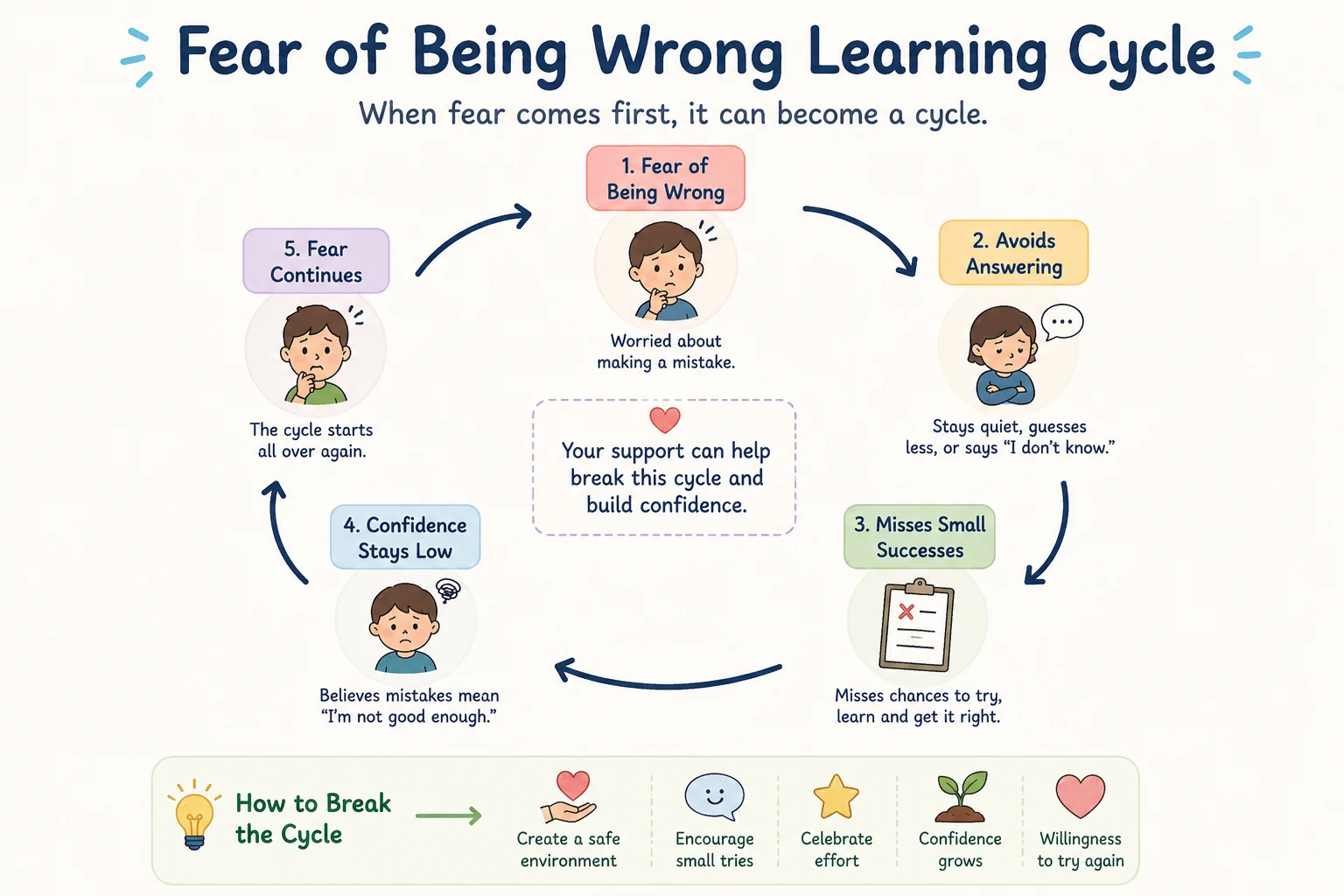
This confidence-building visual helps explain why fear of mistakes can sometimes repeat itself. When children avoid answering, they may miss opportunities to discover that mistakes are a normal part of learning. Over time, small safe learning experiences can help break the cycle and gradually build confidence.
Quiet Children May Hide Their Worries
Not every child shows fear by crying, arguing, or refusing work. Some children hide their worries by becoming quiet. They may complete tasks slowly, avoid attention, and keep their doubts inside.
Quiet children can be easy to overlook because they may not cause obvious problems. But quietness does not always mean calmness. Sometimes quiet children are thinking deeply, worrying privately, or trying hard not to make mistakes in front of others.
This emotional pattern connects naturally with Why Quiet Children Sometimes Doubt Their Learning Ability, because some children carry learning doubt silently rather than openly.
Why It May Look Different at Home
Some parents notice their child seems confident at school but nervous at home. Others notice the opposite. This can feel confusing, but it is very common for children to behave differently across learning environments.
At school, children may follow the group, copy classroom routines, or respond because the structure is clear. At home, learning can feel more personal and emotionally exposed. A parent’s attention may feel loving, but it may also feel intense when the child is unsure.
This is one reason homework can feel harder at home than expected. If this pattern feels familiar, Why Homework Feels Harder at Home Than at School may help explain why home learning can carry different emotional pressure.
Practical Insights for Real Homes
Every child responds differently, and busy families rarely have perfect time or perfect patience. Still, small changes in the emotional atmosphere around learning can sometimes make answers feel less risky.
Some children respond better when mistakes are treated as normal thinking rather than failure. Others feel safer when they are allowed a little thinking time before answering. Some children answer more confidently when parents are nearby but not watching every move too closely.
In many homes, confidence improves through small repeated experiences. A child slowly learns that a wrong answer does not lead to shame, disappointment, or a heavy conversation. Over time, this can make trying feel safer.
| What Parents May Notice | What It May Mean Emotionally |
|---|---|
| The child says “I don’t know” very quickly | They may be avoiding the risk of being wrong |
| The child keeps asking for answers to be checked | They may not fully trust their own thinking yet |
| The child gets upset over one small mistake | The mistake may feel bigger inside than it looks outside |
| The child avoids reading or answering aloud | They may feel exposed when others can hear mistakes |
| The child answers better when relaxed | Emotional safety may be helping their knowledge show |
These behaviours do not mean parents need to fix everything immediately. They simply give useful clues about how the child may be experiencing learning from the inside.
Common Misunderstandings
Fear of getting answers wrong is often misunderstood because it can look like many other behaviours. A child who avoids answering may be seen as lazy. A child who checks constantly may be seen as difficult. A child who becomes upset may be seen as dramatic.
In reality, these behaviours may come from worry, self-doubt, tiredness, or a strong need to feel safe while learning. Children do not always have the words to explain this clearly, so the emotion often comes out through behaviour.
Another misunderstanding is that confident children never worry about mistakes. Many confident children still have moments of doubt. Confidence is not the absence of fear. It is often the slow growth of trust that mistakes can be handled.
Family and Seasonal Context
Fear of wrong answers can become more noticeable during certain times of the school year. Children may feel more sensitive near tests, report cards, school transitions, or after long terms when they are already tired.
After-school timing can also make a difference. A child who seems afraid of answers at 5:30 pm may not feel the same way on a relaxed weekend morning. Tiredness, hunger, noise, and emotional overload can all make learning feel harder.
This does not mean families need a perfect routine. Most homes are busy and imperfect. Sometimes it simply helps to remember that a child’s learning confidence may look different depending on the day, the energy level, and the emotional atmosphere around the task.
Jolyti Note: I’ve noticed that some children do not fear learning itself. They fear the feeling that comes with being wrong. Every child is different, and confidence often grows in small, quiet moments where trying feels safe enough.
Confidence Often Grows Below the Surface
Parents usually notice confidence when it becomes visible. A child answers aloud, tries a difficult question, raises a hand, or keeps going after a mistake. But a lot of confidence grows before it can be seen.
Below the surface, a child may be learning that mistakes are survivable, that adults still care when answers are wrong, and that thinking takes time. These small emotional lessons may not look dramatic, but they matter.
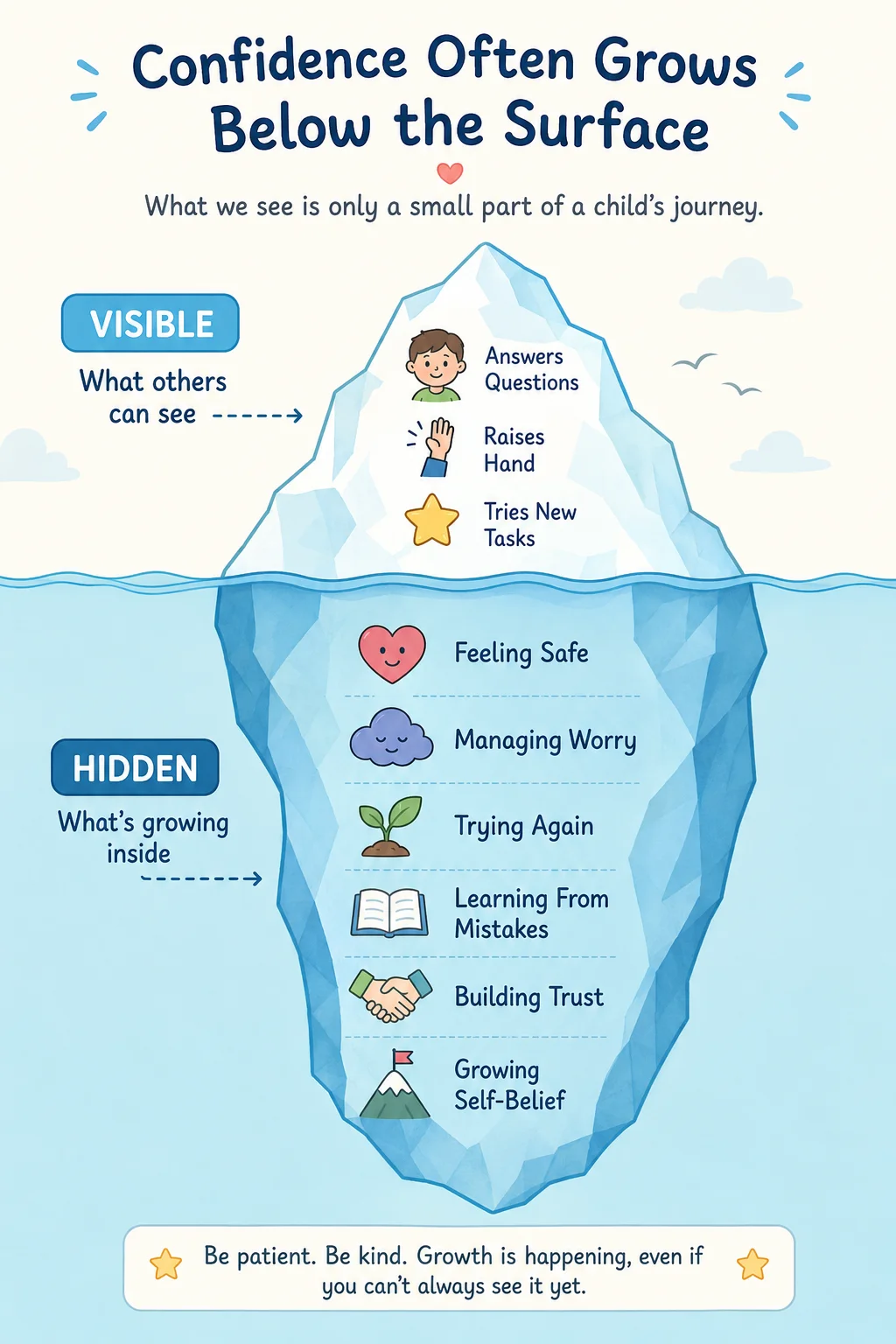
This confidence-building visual is useful here because it reminds parents that progress may be happening even when it is not obvious yet. A child who still hesitates may also be slowly building trust in their own ability to try.
Frequently Asked Questions
Can a smart child still be afraid of getting answers wrong?
Yes. A child can be bright, capable, and still feel nervous about mistakes. Intelligence and confidence are not the same thing. Some children understand the work but still feel uncomfortable showing their answer.
Why does my child say “I don’t know” when they probably know?
Sometimes “I don’t know” is a protective answer. It may help the child avoid the emotional risk of being wrong. This can happen when a child is unsure, tired, embarrassed, or worried about the reaction.
Does fear of wrong answers mean my child has low confidence?
It may suggest that learning confidence is still developing, especially around mistakes. Some children feel confident in play, sport, or friendships but less confident when answers can be judged as right or wrong.
Why is my child more nervous answering at home than at school?
Home learning can feel more personal. A child may worry more about disappointing a parent, even when the parent is being kind. The emotional setting can affect how safe it feels to try.
Will my child grow out of being afraid of mistakes?
Many children become more comfortable with mistakes over time, especially when learning feels emotionally safe. Confidence often grows through repeated small experiences rather than one big change.
Final Thoughts
Signs a child is afraid of getting answers wrong can show up in quiet, emotional, or surprising ways. A child may hesitate, avoid guessing, check constantly, become upset by small mistakes, or hide their worries behind silence.
These behaviours do not mean the child is failing. They often mean the child is still learning how to feel safe with uncertainty. For many children, confidence grows when they slowly discover that wrong answers are part of learning, not proof that something is wrong with them.
In real families, progress may look small. A child may try one answer more willingly, recover from one mistake a little faster, or stay with a task for a few extra minutes. Those small moments matter. They are often where confident learning begins.
Featured image is AI-generated and intended for illustrative purposes only.
Leave a Reply