
Some children seem to lose focus the moment homework or study time begins. They may stare at the page, fidget, ask for snacks, wander away, or become upset before much work is done. For parents, this can feel confusing, especially when the child is capable but still struggles to stay with the task.
Helping children stay focused without pressure often starts with making learning feel smaller, calmer, and emotionally safer. Many children focus better when they do not feel watched, rushed, compared, or forced to stay focused for longer than they can manage.
This does not mean a child is lazy or unwilling to learn. In many real homes, children are tired after school, overstimulated from the day, distracted by noise, or quietly worried about making mistakes. Focus is not only about discipline. It is also connected to confidence, emotional energy, and how safe learning feels.
This article will help you understand how to help children stay focused without pressure using calm, realistic, and confidence-building ideas that can work in busy family life.
Why Focus Feels Different in Real Homes
Many focus tips sound simple when life is quiet. A child sits at a table, follows a routine, removes distractions, and finishes the work. But most family homes do not work that neatly. Parents may be cooking, cleaning, answering messages, helping siblings, or trying to recover from their own busy day.
Children also bring the school day home with them. They may have already spent hours listening, sitting still, following rules, solving problems, and managing friendships. By the time they sit down for homework, their mind may already feel full.
This is why helping children stay focused without pressure often means looking beyond the task itself. A child may not need more pushing. They may need a smaller start, a calmer space, a short reset, or a gentler way to begin.
If the home environment feels noisy or overstimulating, you may also find How to Create a Calm Study Space in a Busy Home helpful.
Why Traditional Focus Advice Sometimes Fails
Traditional focus advice often sounds like this: remove every distraction, make the child sit still, finish everything before stopping, and do not allow breaks until the work is done. This may help some children, but for others it can create more stress.
Some children lose focus because the task feels too big. Others lose focus because they feel watched, corrected, or afraid of getting things wrong. Some children need movement before they can settle. Others need quiet before their mind feels ready to think.
When parents only focus on controlling behaviour, they may miss what is happening underneath. A child who looks distracted may actually be overwhelmed, tired, worried, or trying to avoid the feeling of failure.
Pressure-Based Focus vs Calm Confidence-Based Focus
Focus does not always improve when pressure increases. Many children focus better when learning feels possible, safe, and small enough to manage. This table shows the difference between a pressure-based approach and a calmer confidence-building approach.
| Pressure-Based Focus | Calm Confidence-Based Focus |
|---|---|
| “Finish everything now.” | “Let’s start with one small part.” |
| Long study sessions even when the child is tired | Shorter focus periods that feel manageable |
| Constant correction while the child is working | Gentle guidance after the child has had time to think |
| Focus through fear of being in trouble | Focus through emotional safety and trust |
| Strict control of every distraction | Flexible structure that fits the child and home |
| Success means finishing fast | Success means staying calm enough to keep trying |
This does not mean children should have no structure. Gentle structure can be very helpful. But structure works best when it lowers stress instead of adding more emotional weight.
Make Learning Feel Smaller and Safer
One reason children struggle to stay focused is that the task feels too large before they even begin. A worksheet, reading passage, or revision task may look simple to an adult, but to a tired child it can feel like too much.
Instead of asking a child to finish everything, it can help to shrink the first step. A child who resists a full page may be willing to try two questions. A child who refuses reading may be able to read one paragraph. A child who feels stuck may be able to underline the first word they understand.
Small starts can reduce emotional pressure. Once the child begins calmly, focus may grow naturally because the brain no longer feels trapped by the size of the task.
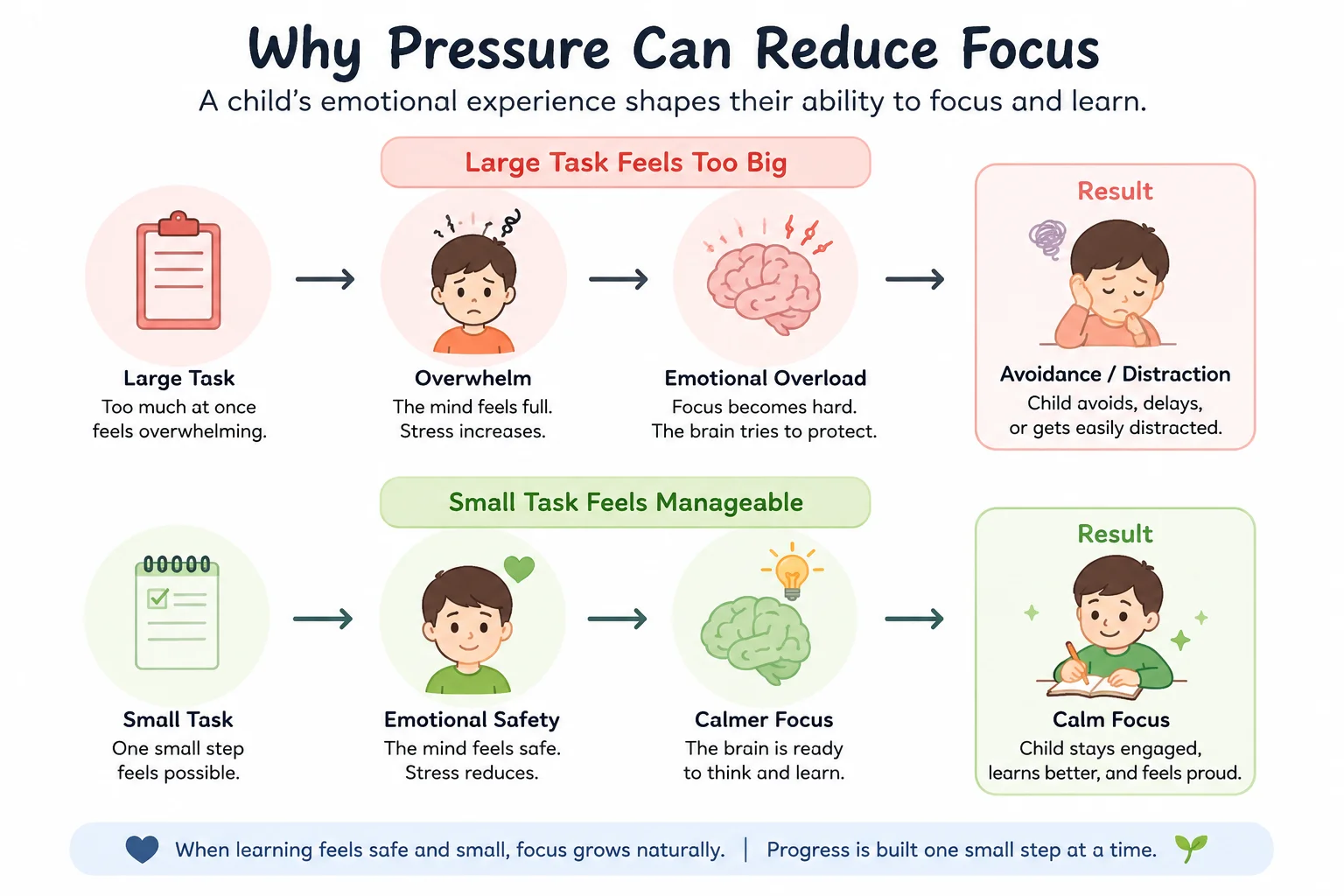
This diagram can help parents see that distraction is not always a behaviour problem. Sometimes it is a sign that the task feels emotionally too big.
Use Shorter Focus Periods Instead of Long Sessions
Some children focus better in short learning blocks. They may work well for ten or fifteen minutes, then slowly become restless, emotional, or distracted. This does not always mean they are not trying. It may mean their focus works better in smaller waves.
Shorter focus periods can make learning feel less endless. A child may think, “I can try this for a little while,” instead of feeling trapped at the table. This small emotional difference can make starting easier.
For some families, shorter study sessions also fit real life better. A calm ten-minute spelling practice, a short reading moment, or one small maths task may be more realistic than trying to create a perfect hour of quiet study.
If your child seems to focus better in smaller blocks, Why Short Study Sessions Work Better for Some Children connects closely with this idea.
A Gentle Study Timer Idea
Some children feel calmer when study time has a clear beginning and ending point. When a session feels endless, they may resist before they even start. A simple timer can sometimes help because the child can see that the focus period will finish.
A Gentle Study Timer Idea: For families who prefer calm, distraction-free focus sessions, the free StudentTimer.com website can help children work in shorter study blocks with built-in breaks.
This can be especially helpful when the goal is not to push harder, but to make study time feel more manageable, predictable, and less overwhelming.
A timer should not feel like pressure. It works best when it is used gently, as a way to show the child, “This will not last forever.”
Reduce Correction While Children Are Still Thinking
Some children lose focus when they feel corrected too often. Parents usually correct because they want to help, but too much correction during the thinking process can make a child feel watched or judged.
This does not mean mistakes should be ignored. It simply means children often need a little space to think before adults step in. A pause can help the child stay connected to the task instead of becoming worried about every small error.
You might allow your child to finish one small section before looking over it together. You might ask, “Can you show me how you were thinking?” before correcting. This keeps the learning moment calmer and gives the child room to feel capable.
If your child becomes upset after small errors, you may also find How to Help a Child Who Gets Upset After Small Mistakes useful.
Help the Body Calm Before Expecting Focus
Focus is not only mental. It is also physical and emotional. A child who has just come home from school may still be carrying noise, movement, social stress, hunger, tiredness, or screen stimulation.
Many children need a transition before learning. This might be a snack, a drink of water, a short walk, quiet time, a small movement break, or a few minutes away from screens. These simple moments can help the body settle before the brain is asked to concentrate again.
This is especially important for children who seem restless before homework. They may not be trying to avoid learning. Their body may simply not feel ready to sit and think yet.
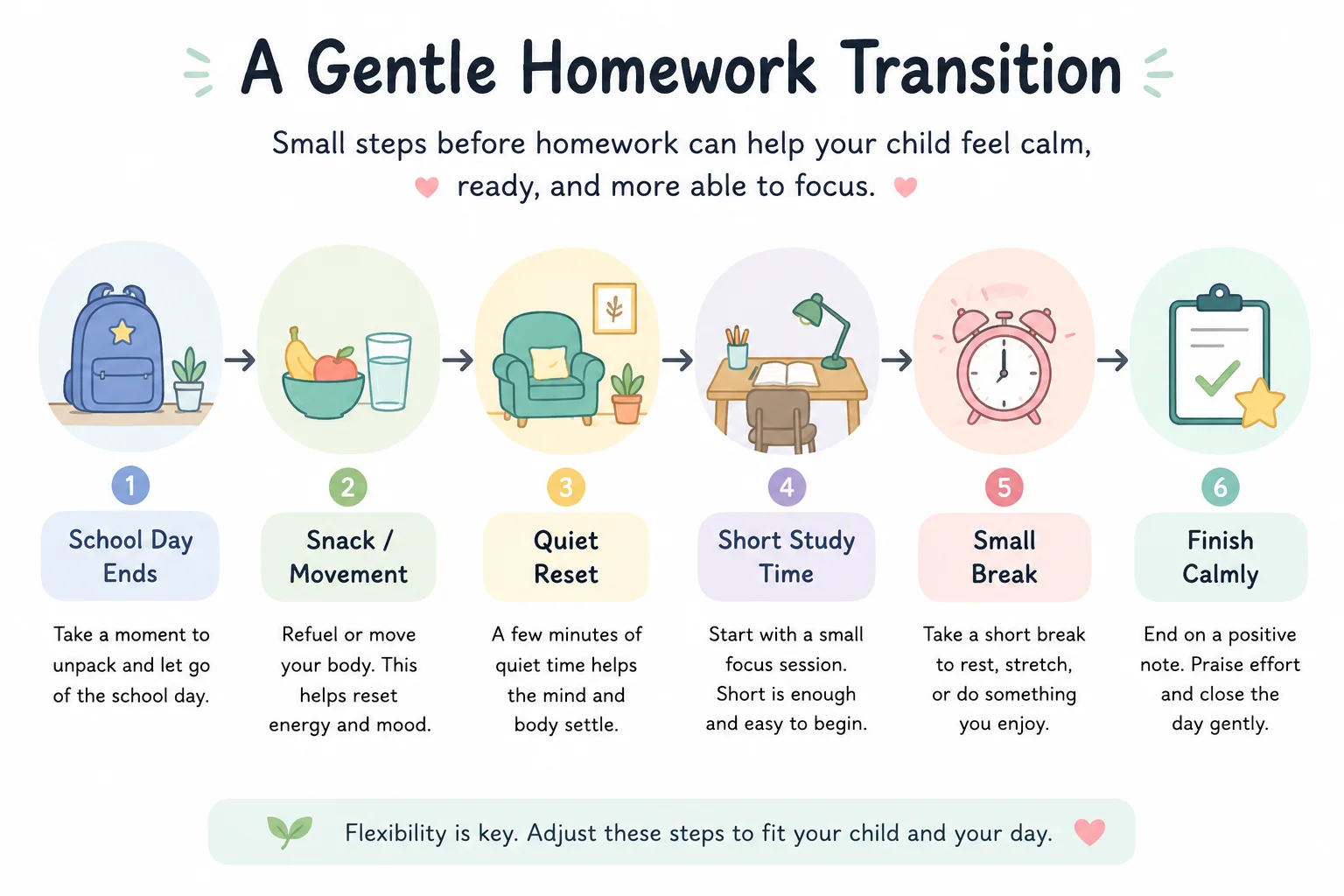
This kind of routine should feel flexible, not strict. The purpose is to help the child arrive at learning more calmly, not to create another rule for the family to manage perfectly.
Build Focus Through Confidence, Not Fear
Children often focus better when they believe they can succeed. When learning feels connected to disappointment, comparison, or being corrected too quickly, children may begin to protect themselves by avoiding the task.
Confidence does not always grow through big rewards or big praise. For many children, it grows quietly through small learning moments that end safely. A child finishes two questions calmly. A child reads one paragraph without panic. A child tries again after a mistake.
These small moments teach children that learning is something they can return to. Over time, this can support stronger focus because the child feels less afraid of the task.
Practical Ways to Support Focus Calmly
Many families do not need a complicated focus system. Small changes can sometimes make learning feel calmer and easier to begin.
- Start with one small task instead of the whole homework load.
- Use short focus periods when your child is tired after school.
- Offer a snack, water, or movement before study time.
- Let your child choose which small task to start with.
- Use a visual timer gently, not as a threat.
- Pause before correcting every mistake.
- End a short session calmly when possible.
- Notice effort, patience, and returning to the task.
These ideas are not rules. They are small options parents can try depending on the child, the day, and the energy in the home.
Common Mistakes That Can Increase Pressure
Parents usually make these mistakes while trying to help. They are common, especially when parents feel worried about school progress.
- Expecting focus to look the same in every child.
- Turning every distraction into a conflict.
- Correcting too quickly while the child is still thinking.
- Forcing long sessions when the child is already exhausted.
- Comparing siblings or classmates.
- Assuming movement always means the child is not listening.
It can help to remember that focus often improves slowly. A calmer learning relationship may matter more than one perfect homework session.
Different Children Respond to Focus Differently
Some children focus best in quiet spaces. Others focus better with soft background noise. Some children need to move before they sit down. Others need emotional reassurance before they can start.
Quiet children may hide their overwhelm by becoming slow or distant. Energetic children may show their overwhelm through movement. Sensitive children may lose focus when they feel corrected too often. Independent children may focus better when parents give them more space.
This is why helping children stay focused without pressure needs flexibility. The goal is not to force every child into the same study style. The goal is to understand what helps each child feel calm enough to try.
Family and Seasonal Context
Children’s focus can change during the school year. During assessment weeks, busy terms, winter evenings, or after holidays, children may feel more tired than usual. Their attention may become shorter, and their emotions may sit closer to the surface.
Family life also affects focus. A child may struggle more after poor sleep, illness, busy weekends, friendship problems, travel, or too much screen time. These changes do not mean parents are failing. They simply show that children’s learning energy is connected to real life.
During these times, a smaller and calmer approach can be more helpful than pushing harder.
Jolyti Note: I’ve noticed some children become more open to learning when the atmosphere around them feels lighter. Focus often grows quietly when children feel safe enough to start small, make mistakes, and return again without shame.
Frequently Asked Questions
How can I help my child focus without pressure?
You can help your child focus without pressure by making the task smaller, using shorter focus periods, reducing constant correction, and creating a calm transition before study time begins.
Why does my child focus at school but not at home?
Home feels emotionally different from school. Children may release tiredness, stress, or frustration once they are home. They may also have less structure and more distractions around them.
Are short study sessions enough for children?
Short study sessions can be enough for many children when they are repeated calmly over time. The quality of focus often matters more than how long a child sits at the table.
Should I remove all distractions during homework?
Not always. Some children need quiet, while others focus better with soft background sound or gentle movement before learning. The best environment depends on the child.
Does pressure help children focus better?
Pressure may create short-term urgency, but too much pressure can reduce confidence and make children avoid learning. Calm structure usually supports focus better over time.
Final Thoughts
Helping children stay focused without pressure is not about creating perfect routines or controlling every distraction. In many homes, it begins with understanding why focus feels hard for a child in that moment.
Some children need shorter sessions. Some need movement. Some need quiet. Some need fewer corrections. Some need to feel that mistakes will not turn learning into shame. These needs are not signs of weakness. They are part of how children grow.
When learning feels smaller, calmer, and safer, children often become more willing to try. Progress may be slow, but small calm learning moments can still build confidence, focus, and trust over time.
Featured image is AI-generated and intended for illustrative purposes only.
Leave a Reply