
Many parents have seen this happen. A child studies spelling words, maths facts, or a school topic, seems to understand it, and then forgets it soon after. Sometimes it happens the same afternoon. Sometimes it happens the next morning.
Why children forget things they just studied is often connected to attention, tiredness, emotions, repetition, and how safely the information settles in the brain. Forgetting does not always mean a child was lazy, not listening, or unable to learn.
This can still feel frustrating for parents, especially when family time is already busy. A child may have studied properly, but then their mind goes blank during homework, revision, or a test. In that moment, it is easy to worry that the learning did not work.
This article will explain why children forget things they just studied, why it happens in real homes, and how parents can support memory in calm, practical, and confidence-building ways.
Why Forgetting Feels So Frustrating at Home
In real family life, studying does not usually happen in perfect conditions. A child may be tired after school, hungry, distracted by noise, thinking about friends, or still carrying emotions from the day.
Parents may also be tired. They may be cooking dinner, helping another child, answering messages, or trying to keep the evening moving. So when a child forgets something they just studied, it can feel like the whole effort was wasted.
But forgetting is not always a sign that nothing went in. Sometimes the information is still new, weak, or not yet easy to recall. Memory often needs time, calm repetition, and emotional safety before it becomes strong.
What Most Study Advice Misses
Many study tips focus on getting children to remember more. They may suggest more practice, more revision, or more discipline. These ideas can sometimes help, but they do not always explain what is happening inside the child.
A child may forget because the study session was too long. Another child may forget because they felt nervous. Another may understand the idea during homework but need more time before they can remember it alone.
This is why it helps to think about memory gently. Children are not machines. They do not always remember information just because they saw it once or seemed to understand it once.
Why Children Forget Things They Just Studied
Children often forget things they just studied because the information has not become strong enough in memory yet. New learning is usually fragile. It can be affected by tiredness, distractions, stress, hunger, poor sleep, or not enough repetition.
Sometimes children understand something while an adult is helping them, but later struggle to recall it without support. This is common. It does not always mean the child did not learn. It may mean the memory pathway still needs strengthening.
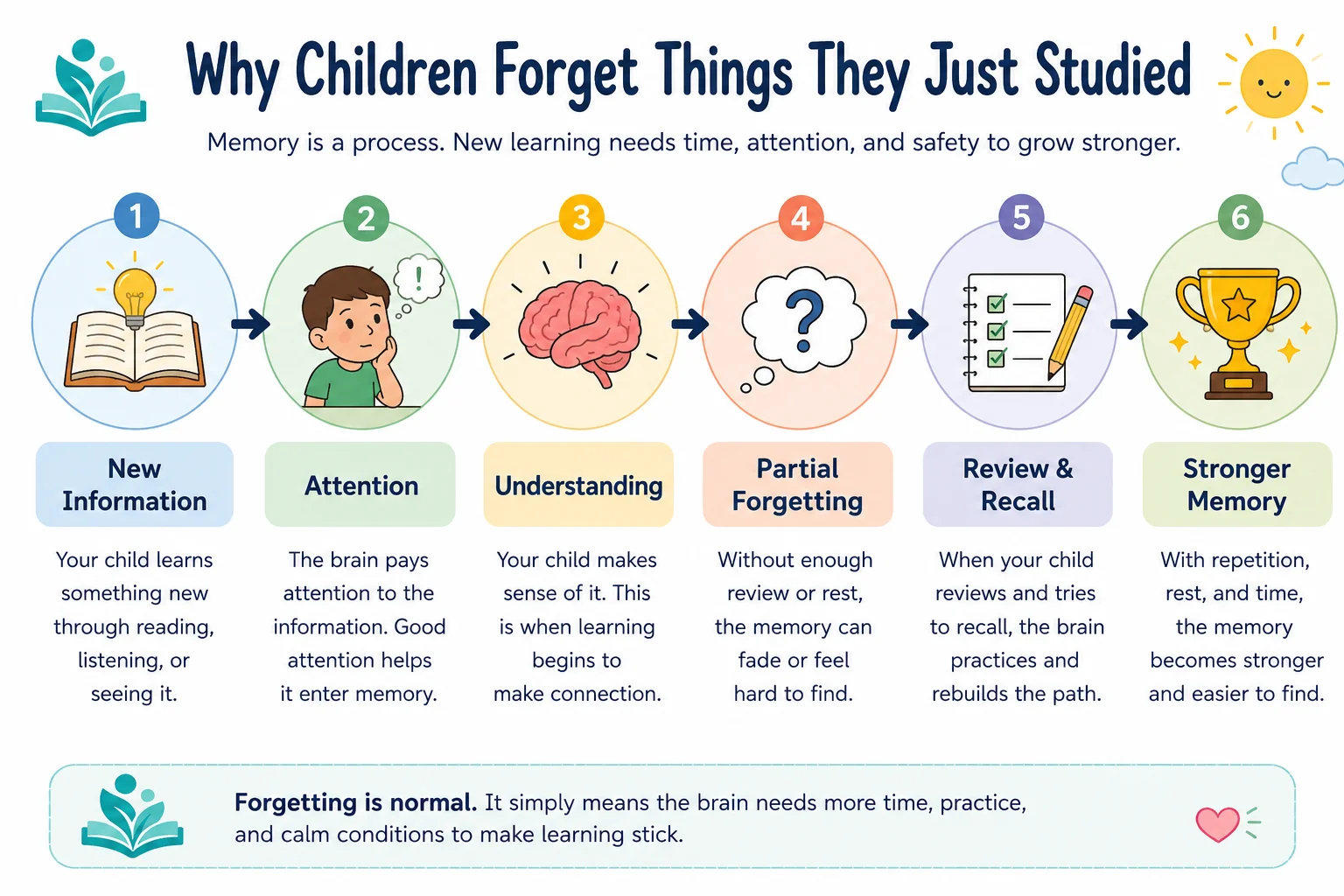
This kind of visual can help parents see that forgetting is not always the end of learning. Sometimes it is one step in the memory-building process.
Learning and Remembering Are Not Always the Same
One of the most helpful ideas for parents is this: learning something and remembering it later are connected, but they are not exactly the same.
A child may understand a maths method during homework but forget the steps the next day. A child may read a paragraph and understand it, but struggle to explain it later. This does not always mean the learning failed.
| Learning | Remembering |
|---|---|
| Understanding new information | Bringing information back later |
| Can happen during a lesson or study session | Often needs time and repeated practice |
| May feel clear when help is nearby | Can feel harder when the child is alone |
| Can happen quickly for some topics | Usually becomes stronger gradually |
| Does not always show immediately | Improves when children revisit information calmly |
This is why parents may see a child study well but still forget soon after. The child may have started learning, but the remembering part may still be developing.
Mental Fatigue Can Make Memory Weaker
Children use a lot of mental energy during the school day. They listen, follow instructions, manage friendships, move between subjects, and try to keep up with classroom expectations.
By the time they study at home, their brain may already feel full. A tired child may still try hard, but new information may not settle as easily.
This is one reason a child may forget things they just studied after school. It may not be a motivation problem. It may be an energy problem.
If homework often feels heavy after school, you may find How to Make Homework Feel Less Stressful After School helpful.
Emotions Can Crowd Out Memory
Memory works better when children feel safe enough to think. When a child feels rushed, watched, corrected too quickly, or afraid of getting answers wrong, their brain may focus more on the emotion than the information.
This can make recall harder. The child may actually know more than they can show in that moment.
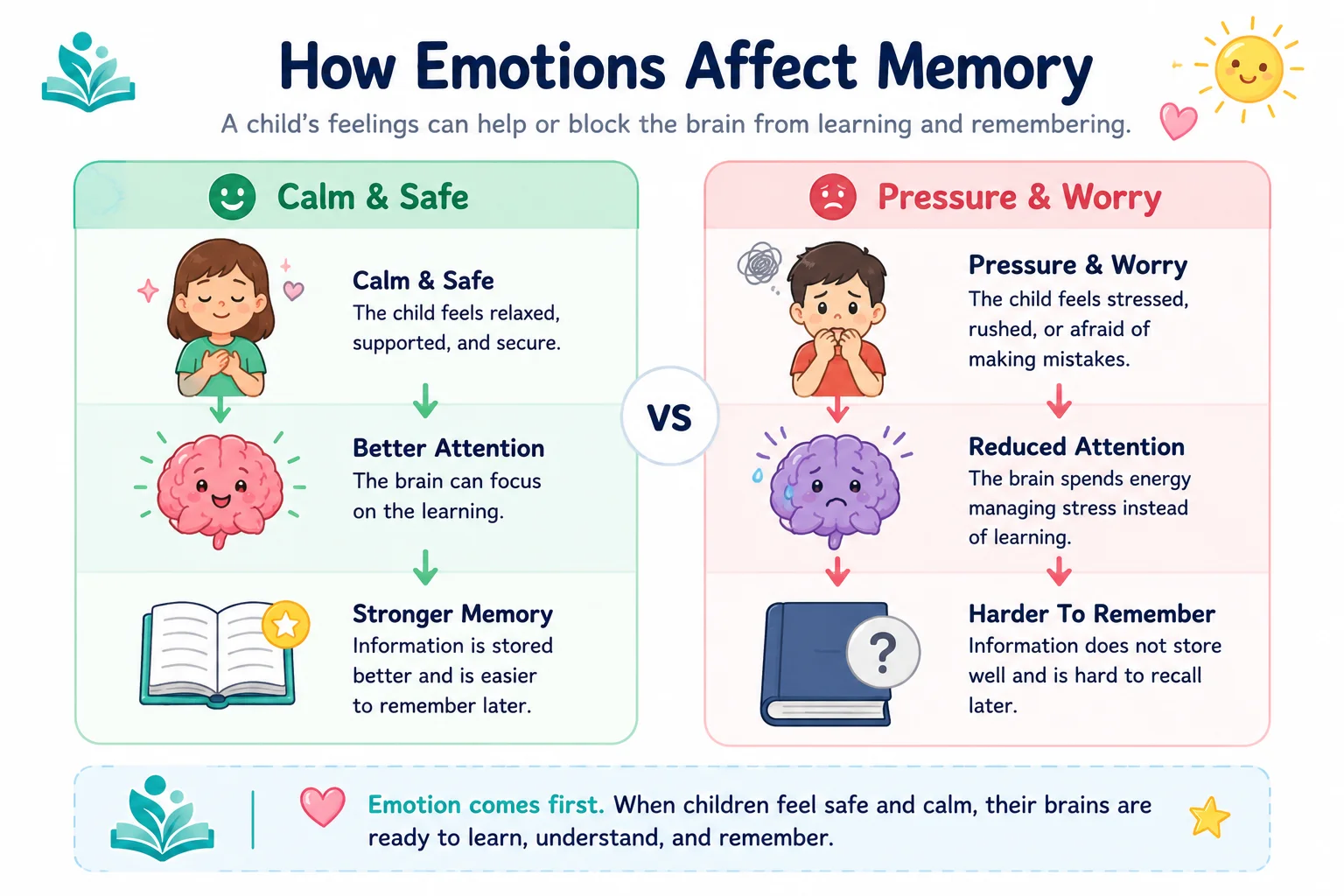
If your child becomes upset after small mistakes, you may also find How to Help a Child Who Gets Upset After Small Mistakes useful.
Attention and Memory Work Together
For children to remember something, their brain first needs enough attention to take it in. If attention keeps moving away, the information may not be stored clearly.
This does not mean the child is being careless. Children can be distracted by noise, screens, siblings, hunger, tiredness, or worries. Some children also look like they are paying attention, but their mind is already somewhere else.
When parents understand this, the question changes. Instead of only asking, “Why did you forget?” it may help to wonder, “Was my child calm and focused enough for this information to settle?”
If distraction is a regular challenge, Why Children Get Distracted During Homework So Easily connects closely with this topic.
Why Shorter Study Sessions Can Help
Some children remember better when study time is shorter and repeated. Long study sessions can make a child tired, restless, or emotionally overloaded. Once that happens, memory may become weaker.
Shorter sessions can feel more achievable. A child may be more willing to focus for a small amount of time than sit through a long block that feels endless.
This matters because memory often grows through returning to information, not just staying with it for a long time once.
A Gentle Study Timer Idea
Many parents notice something interesting when study time feels smaller and more manageable. A child who struggles to remember information after a long homework session may recall more after several shorter learning periods spread across the week.
This is one reason some families find simple study timers helpful. The timer itself does not create memory, but it can make it easier for children to focus on one task at a time and revisit learning without feeling overwhelmed.
A Gentle Study Timer Idea: For families who prefer calm, distraction-free focus sessions, the free StudentTimer.com website can help children work in shorter study blocks with clear breaks.
This can be especially helpful when the goal is not to push harder, but to make study time feel more manageable, predictable, and less overwhelming.
A timer works best when it feels supportive, not stressful. It can gently show a child, “This focus time has an ending,” which may help study feel less intimidating.
Why Forgetting Can Be Part of Learning
Forgetting can feel like failure, but it can also be part of how learning becomes stronger. When children revisit something they partly forgot, the brain works to rebuild the memory.
That effort can help the information become stronger over time. This is why calm review often matters more than one perfect study session.
A child may forget today, remember a little tomorrow, and understand more clearly next week. Progress may be happening even when it looks uneven.
Practical Insights for Busy Families
Many families do not need a complicated memory system. Small, realistic changes can sometimes make study feel calmer and help memory grow more naturally.
- Some children remember better after short study blocks than long sessions.
- Revisiting information calmly can help memory become stronger.
- Children often remember less when they feel rushed or worried.
- A small break can sometimes help the brain reset.
- Sleep, food, emotions, and tiredness can all affect recall.
- Forgetting does not always mean the child did not try.
These ideas are not strict rules. They are gentle reminders that learning happens inside real family life, not perfect conditions.
Common Misunderstandings About Forgetting
When children forget things they just studied, it is easy to assume the worst. But many common assumptions do not tell the whole story.
- Forgetting does not always mean a child was not listening.
- Needing repetition does not mean a child is not smart.
- Slow recall does not always mean poor understanding.
- Blanking out under pressure does not mean the child knows nothing.
- Remembering slowly is still remembering.
- Different children build memory at different speeds.
When parents see forgetting with more understanding, it can reduce frustration for both the parent and the child.
Family and Seasonal Context
Children may forget more during busy seasons. School-term fatigue, assessment weeks, late nights, illness, family stress, holidays, or changes in routine can all affect memory.
Some children also struggle more during transitions. After a holiday, a busy weekend, or a difficult school day, their brain may need more time before learning feels steady again.
These changes do not mean parents are doing something wrong. They simply show that children’s learning energy is connected to real life.
Jolyti Note: I’ve noticed that some children seem to remember more when learning feels calm, small, and repeatable. Every child is different, and sometimes memory grows quietly before adults can clearly see the progress.
Frequently Asked Questions
Is it normal for children to forget things they just studied?
Yes, it can be normal. New information is often fragile at first. Many children need repeated exposure before they can remember it confidently later.
Does forgetting mean my child was not paying attention?
Not always. A child may have paid attention but still need more time, rest, or repetition before the memory becomes strong.
Why does my child remember games but forget homework?
Children often remember things more easily when they are interested, relaxed, or emotionally connected to the activity. Homework may feel more pressured, which can affect memory.
Can stress make children forget what they studied?
Yes. Stress can make it harder for children to focus and recall information. A child may know something but struggle to bring it back when they feel worried.
Can short study sessions help children remember better?
Short study sessions can help some children because they reduce overwhelm and make repeated practice easier. Many children remember better through calm repetition over time.
Final Thoughts
Why children forget things they just studied is not always a simple question. Forgetting can come from tiredness, distraction, pressure, weak memory pathways, or simply needing more time with the information.
For parents, the goal is not to make every study session perfect. It is to understand what may be happening and support learning in a way that feels calm, realistic, and emotionally safe.
Children are still developing their attention, confidence, memory, and learning habits. Forgetting today does not mean they cannot learn tomorrow. Small, calm, repeated learning moments can still build real confidence over time.
Featured image is AI-generated and intended for illustrative purposes only.
Leave a Reply