
Some parents start worrying when their child can only focus for ten or fifteen minutes before drifting away, getting restless, or asking for a break. It can feel confusing when other children seem able to sit longer with homework or revision while your own child loses energy quickly.
Why short study sessions work better for some children often comes down to emotional energy, attention, confidence, and how safe learning feels. Some children learn more effectively in smaller blocks because their brains stay calmer, less overwhelmed, and more able to absorb what they are studying.
This does not mean a child is lazy, behind, or less capable. In many homes, children are already tired after school, overstimulated from the day, or carrying quiet pressure about making mistakes. A long study session can feel much heavier than it looks from the outside.
This article will explain why short study sessions work better for some children, how shorter learning blocks can protect confidence, and why small calm study moments may be more useful than forcing long periods of focus.
Why Study Time Feels Different in Real Homes
Many study routines look simple when written down. A child sits at a desk, follows a plan, focuses for a set time, and finishes calmly. Real homes are usually not that neat. Parents may be cooking, answering messages, helping siblings, cleaning up, or trying to manage their own tiredness after a long day.
Children also bring the school day home with them. They may have spent hours listening, sitting still, changing subjects, managing friendships, following rules, and trying not to make mistakes. By the time they sit down to study, their mind may already feel crowded.
This is why short study sessions can work better for some children. They give the child a smaller emotional load to carry. Instead of facing a long block of work, the child only needs to manage one calm piece of learning at a time.
What Most Study Advice Misses
Common study advice often focuses on discipline, routine, and longer concentration. These ideas can help some children, but they do not explain why another child may feel overwhelmed after only a short time.
What many parents are really seeing is not just attention span. They may be seeing emotional energy, confidence, pressure, tiredness, and fear of getting things wrong all mixing together. A child can understand the work but still struggle to stay emotionally steady for a long study session.
Some children need study time to feel small before it can feel safe. When the task feels safe, they are often more willing to begin, try, and return later.
Why Some Children Learn Better in Small Bursts
Some children focus best in short, clear learning moments. They may work well for ten or fifteen minutes, then slowly lose energy, become restless, rush, or start making mistakes. This does not always mean they are not trying. It may mean their focus works better in smaller waves.
Short study sessions give these children a chance to stop before frustration becomes too big. This can help them finish while still feeling capable. Over time, that feeling matters because children often remember how learning felt, not just what they learned.
In many homes, small bursts of learning can also fit better around family life. A short session after a snack, a small review before dinner, or a quiet ten-minute practice can feel more realistic than trying to create a perfect study hour every day.
Mental Energy Runs Out Faster for Some Children
Children do not all use mental energy at the same speed. Some can sit and focus for longer periods without much trouble. Others become mentally tired much faster, especially after a busy school day.
A child may start strongly and then slowly become distracted, emotional, or frustrated. This can happen even when the work is not too hard. Their brain may simply be running low on calm focus.
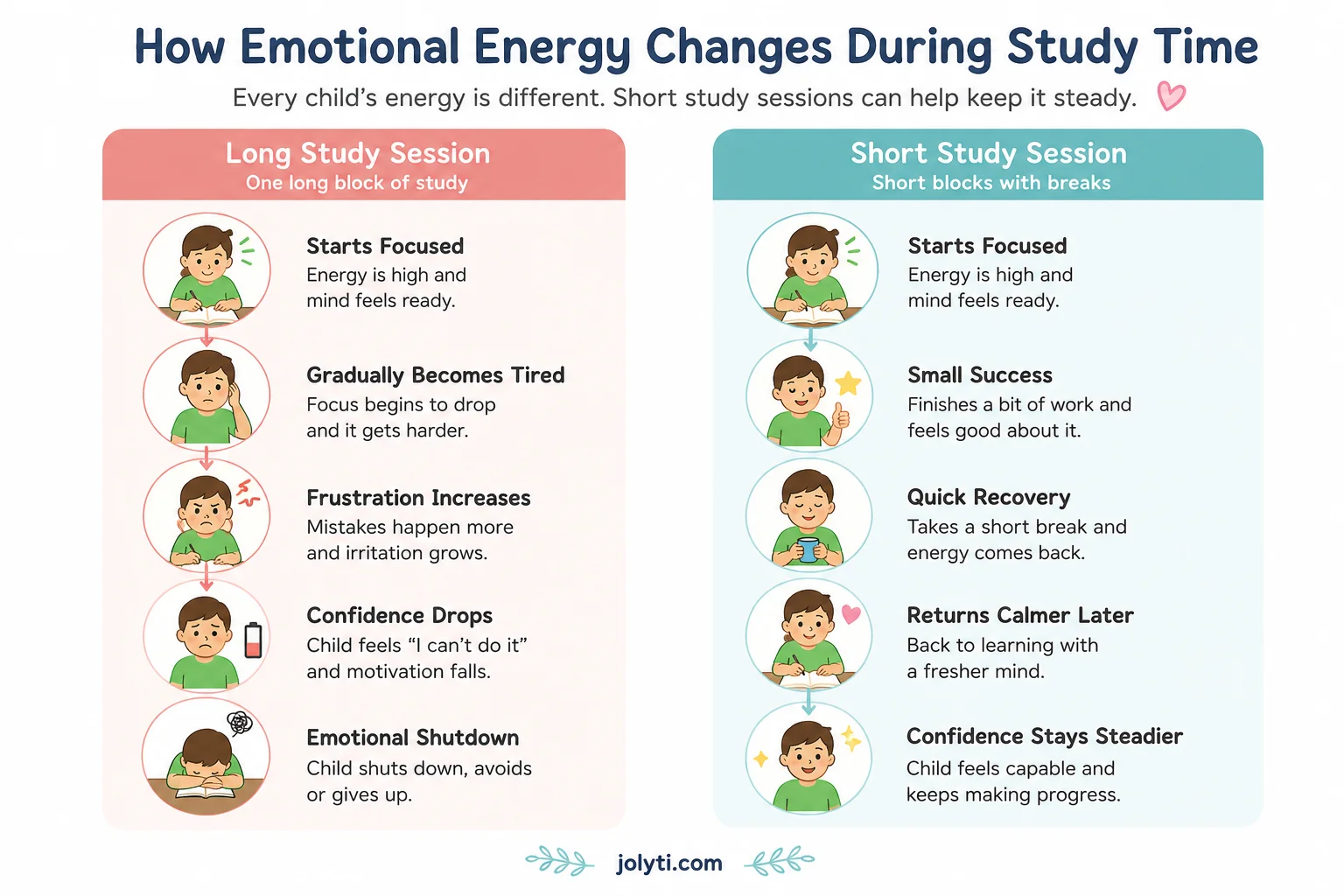
This kind of visual can help parents see that a child’s focus is not always about effort alone. Sometimes emotional energy drops before the child knows how to explain it.
Short Sessions Can Reduce Emotional Resistance
For some children, the hardest part of studying is not the work itself. It is the feeling that the task will be too long, too difficult, or too stressful. When study time feels endless, children may delay, complain, or shut down before they even begin.
Shorter study sessions can make learning feel less threatening. A child may think, “I can try this for a little while,” instead of feeling trapped by a large amount of work. That small emotional difference can make starting much easier.
This connects closely with homework stress after school, because many children resist learning more when their emotional energy is already low. If this pattern feels familiar, you may also find How to Make Homework Feel Less Stressful After School helpful.
Long Study Sessions vs Short Study Sessions
Longer study is not automatically bad. Some children enjoy it and learn well that way. But for children who become tired, overwhelmed, or worried quickly, shorter sessions can sometimes protect both learning and confidence.
| Long Study Sessions | Short Study Sessions |
|---|---|
| Can feel emotionally heavy after school | Often feels more manageable for tired children |
| Focus may slowly drop over time | Focus can stay fresher in smaller blocks |
| Frustration may build near the end | Children may stop before overwhelm grows |
| Can make some children avoid starting | Can make starting feel less scary |
| May look productive but feel draining | May look small but feel more successful |
| Can leave sensitive learners feeling defeated | Can help protect confidence through small wins |
This table is not saying every child needs short study sessions. It simply shows why some children may learn better when study time feels smaller, calmer, and easier to return to.
Some Children Need Recovery Time Between Focus
Some children focus strongly for a short time and then need a reset. That reset might be quiet, movement, water, a snack, or simply a few minutes away from the task. This is not always avoidance. Sometimes it is the child’s way of recovering enough to keep learning.
Children who are active, sensitive to noise, easily worried, or deeply imaginative may need more recovery space between focus periods. If parents only look at the break, it may seem like distraction. But if they look at the whole pattern, they may notice the child returns calmer afterward.
In busy households, this can be especially useful. A child may not need a perfect study routine. They may simply need study time to come in smaller pieces that their mind can handle.
Confidence Often Grows Through Small Successes
Confidence is not built only through big achievements. For many children, it grows through small moments where learning feels possible. Finishing a short task calmly can sometimes build more confidence than struggling through a long session while feeling defeated.
Short study sessions can create more chances for successful endings. A child may finish one set of spelling words, one maths problem, one reading page, or one small review. These small wins quietly teach the child, “I can do this.”
This matters because some children lose confidence quickly when learning feels too big. A smaller study session can give them a safer place to try without feeling like the whole evening depends on their performance.
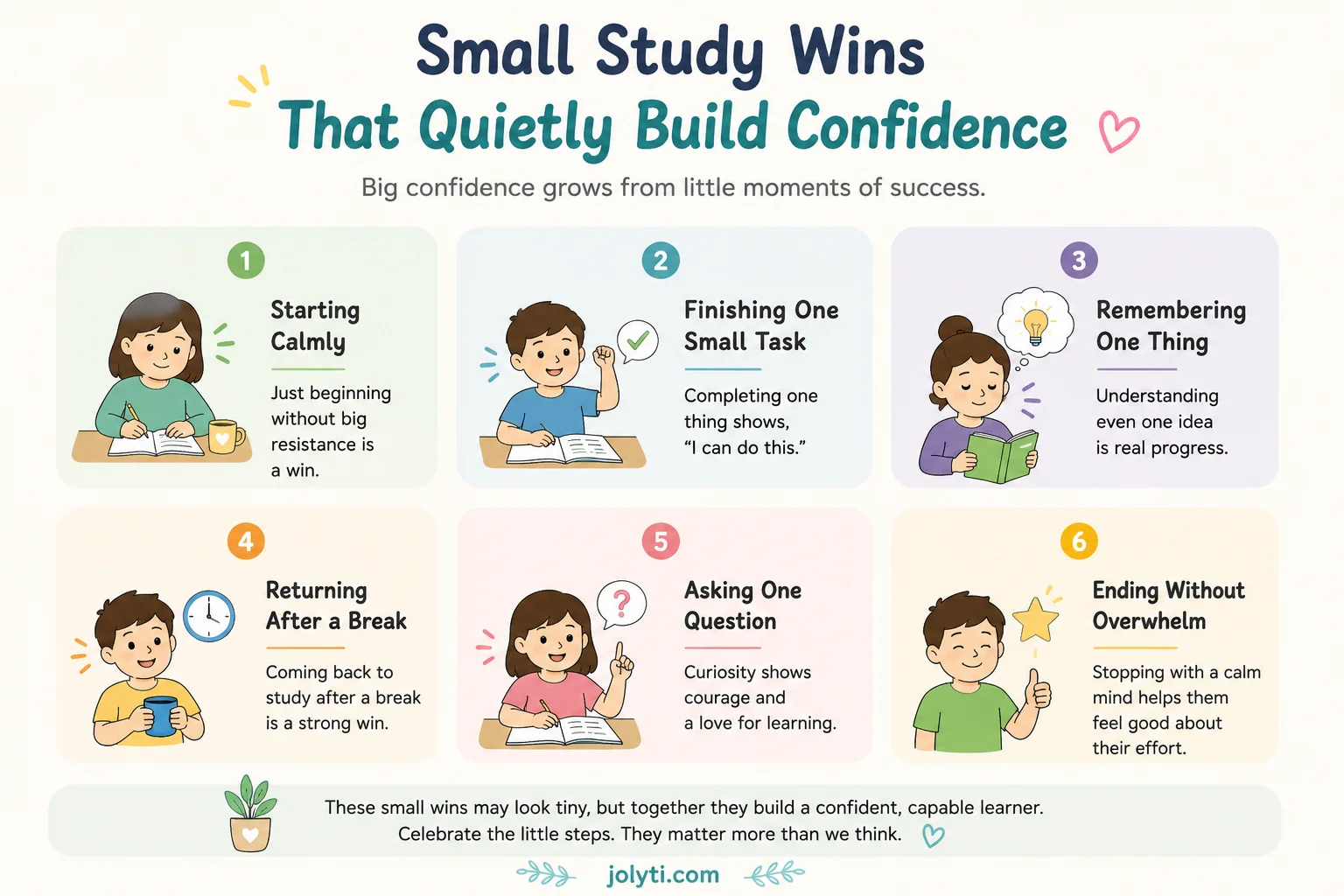
This kind of infographic can help parents notice progress that may otherwise be easy to miss. Not every learning win looks big from the outside.
Quiet Children Sometimes Hide Their Overwhelm
Some children do not clearly say when study feels too much. They may become quiet, slow, distracted, or distant. Parents may think the child is not interested, when the child may actually feel mentally full.
Quiet overwhelm can be hard to spot because it does not always look dramatic. A child may stare at the page, erase work repeatedly, avoid eye contact, or say “I don’t know” even when they partly understand.
This can be linked to fear of mistakes. Children who worry about being wrong may become tired faster because they are not only doing the work. They are also managing the emotional pressure around the work. If this sounds familiar, How to Help a Child Who Gets Upset After Small Mistakes may connect naturally with this topic.
Why Longer Study Does Not Always Mean Better Learning
Long study sessions can look productive from the outside. A child may be sitting at the table for a long time, but that does not always mean learning is happening deeply. Sometimes the child is only staying in place while their mind has already become tired.
For some children, shorter sessions improve the quality of attention. They may remember more, feel calmer, and come back with less resistance later. This is why the question is not only, “How long did my child study?” It is also, “How did my child feel while learning?”
Learning does not always need to look intense to be meaningful. Sometimes calm, short, repeated learning moments create stronger confidence than one long session filled with frustration.
Practical Insights for Busy Families
Many families do not need a strict study system. Small changes can sometimes make study time feel more realistic and less emotionally heavy.
Some children respond better when the session has a clear beginning and end. Others feel calmer when only one small task is placed in front of them. Some children need movement before study, while others need quiet after school before they can think clearly.
For many children, the goal is not to make study perfect. The first goal is often to make learning feel safe enough to begin and small enough to finish.
A Gentle Study Timer Idea: Some children feel calmer when study time has a clear beginning and ending point. Smaller timed sessions can help learning feel more manageable instead of endless.
For families who want a simple option, the free StudentTimer website includes calm study sessions with built-in breaks for shorter focus periods.
Common Misunderstandings
Short study sessions can be misunderstood, especially when parents are worried about school progress. These misunderstandings are common, and they do not mean parents are doing anything wrong.
Short focus can look like laziness when it may be emotional tiredness. Needing breaks can look like avoidance when it may be recovery. A child who studies better in small blocks may still be thoughtful, capable, and willing to learn.
It can also be easy to compare siblings. One child may sit for a long time, while another needs shorter bursts. Different study patterns do not always mean one child is more serious than the other. They may simply have different learning needs.
Family and Seasonal Context
Short study sessions may become even more helpful during busy school terms, assessment weeks, winter evenings, or after long days filled with activities. During these times, children may have less emotional energy left for extended concentration.
In some homes, a calm study space can make shorter learning blocks work even better. A quiet corner, a cleared table, or a small predictable place to begin can help children feel more settled. If you are thinking about the home environment, How to Create a Calm Study Space in a Busy Home may support this article naturally.
Jolyti Note: I’ve noticed some children become much calmer once study time stops feeling endless. Every child is different, but many seem to gain confidence through small learning moments that feel safe, finished, and manageable.
Frequently Asked Questions
Why do short study sessions work better for some children?
Short study sessions work better for some children because they reduce emotional overload and help attention stay fresher. Some children learn more effectively when study feels small, calm, and manageable.
Does needing short study sessions mean my child has poor focus?
Not always. Some children can focus well in small bursts but become tired during longer sessions. This can be connected to emotional energy, school fatigue, confidence, or how much pressure the child feels.
Can short study sessions still help with school progress?
Yes. Many children can make steady progress through short, repeated study sessions. Learning quality often matters more than how long a child sits at a table.
What if my child studies well one day but struggles the next?
This is common. Children’s focus can change depending on sleep, school pressure, mood, confidence, hunger, noise, and emotional tiredness. Inconsistent study energy does not always mean a child is not trying.
Are short study sessions only for younger children?
No. Older children can also benefit from shorter study blocks, especially when they feel overwhelmed by large tasks or long revision periods. Some children learn better when study is broken into calmer pieces.
Final Thoughts
Why short study sessions work better for some children is not only about attention span. It is also about emotional energy, confidence, tiredness, and how safe learning feels in the moment.
Some children do not need more pressure to study longer. They may need learning to feel smaller, calmer, and easier to return to. A short session that ends with confidence can sometimes be more valuable than a long session that ends in frustration.
Parents do not need to create perfect routines for learning to matter. In real homes, small calm study moments can still build trust, confidence, and progress over time.
Featured image is AI-generated and intended for illustrative purposes only.
Leave a Reply