
Many parents quietly worry when learning only seems to happen after promises, treats, stickers, screen time, or rewards. In busy homes, it can start to feel like children will only try if something is waiting at the end. Over time, this can leave parents feeling tired and unsure how to encourage learning without constant negotiation.
Helping children build learning confidence without rewards often starts with making learning feel emotionally safer instead of more performance-focused. Many children become more willing to try when mistakes feel less threatening, progress feels manageable, and learning feels connected to curiosity rather than prizes.
For many families, this can feel difficult to balance. Parents are already managing work, dinner, tired children, emotional meltdowns, homework resistance, and different personalities under the same roof. Reward systems can sometimes feel like the quickest way to keep things moving, especially after long days.
The good news is that confidence does not usually grow through perfect routines or constant motivation. In many homes, it grows quietly through repeated small experiences where children begin to feel capable, safe, understood, and less afraid of getting things wrong.
Real Family Learning Reality Check
In real family life, learning rarely happens in calm picture-perfect moments. Some children come home mentally exhausted from school. Others still carry emotional stress from social situations, classroom pressure, noise, or simply trying to keep up all day.
Parents are often helping children with learning while also preparing meals, managing siblings, replying to work messages, and handling bedtime routines. This changes the emotional atmosphere around learning more than many people realise.
A child who looks “unmotivated” may actually feel mentally overloaded, discouraged, or afraid of failing again. In many homes, learning confidence also changes from day to day. A child may feel capable one evening and completely doubtful the next.
Why Reward-Based Motivation Sometimes Stops Working
Rewards are not automatically harmful. Many families use them occasionally because they help create short-term momentum during difficult periods. But when rewards become the main reason a child learns, some children slowly begin connecting learning with external approval instead of inner confidence.
Over time, children may start asking, “What do I get if I finish?” or “Do I still have to do it if there’s no reward?” Sometimes this happens because rewards accidentally shift attention away from the learning experience itself.
Some children are also emotionally sensitive to pressure, even when adults are trying to encourage them kindly. A child who already fears mistakes may quietly interpret rewards as a sign that doing well is the only way to make others happy.
This is one reason some children lose confidence quickly after small setbacks. Our article on How to Help a Child Who Gets Upset After Small Mistakes explores how emotional reactions to mistakes can quietly affect learning confidence over time.
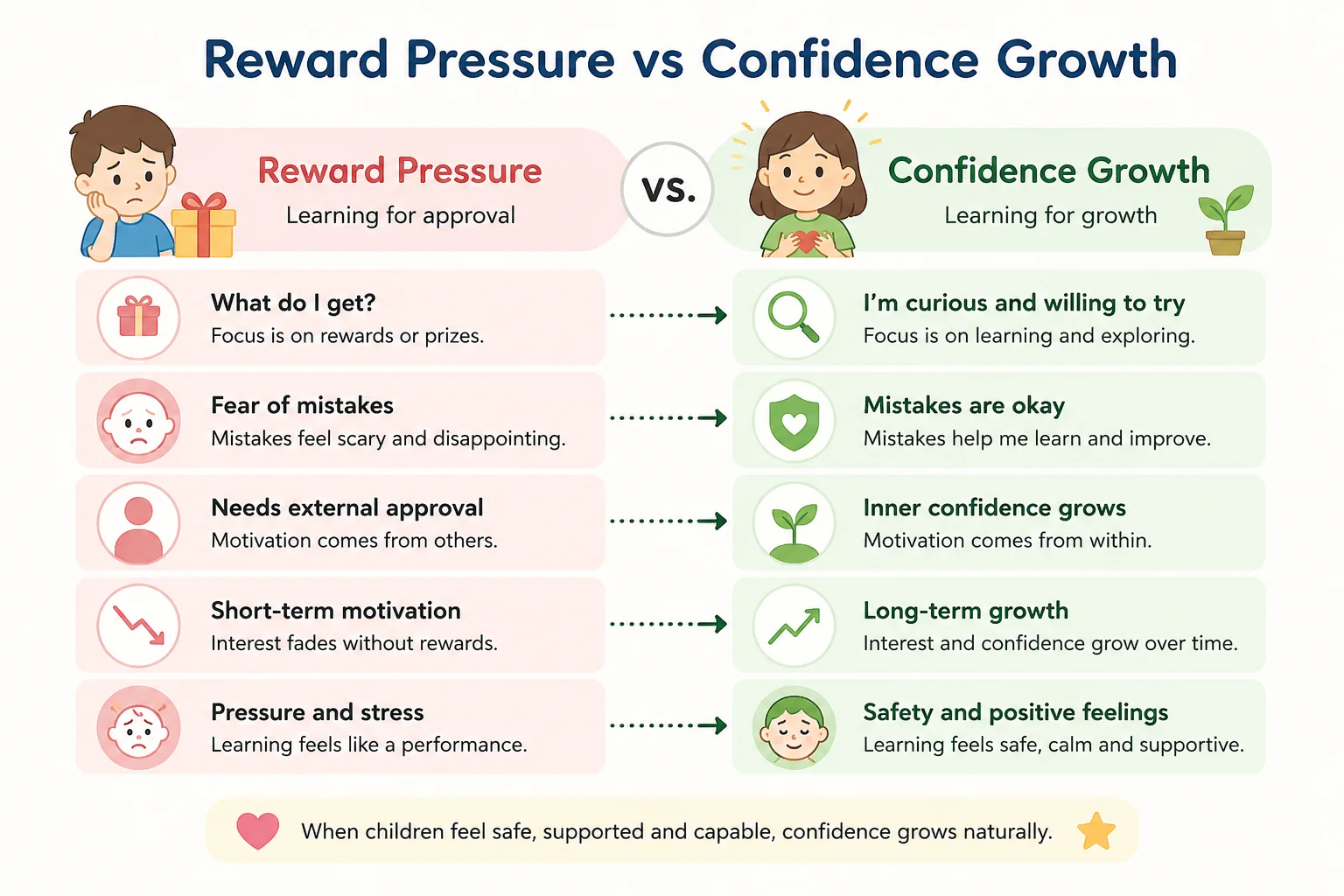
| Reward-Focused Learning | Confidence-Focused Learning |
|---|---|
| “What do I get?” | “I can try this slowly.” |
| Focuses on prizes or approval | Focuses on effort, safety, and progress |
| Mistakes may feel more risky | Mistakes feel more manageable |
| Motivation depends on outside rewards | Confidence grows through repeated small wins |
| Learning may feel like performance | Learning feels more human and flexible |
Make Learning Feel Smaller and Safer
One of the most overlooked ways to build learning confidence without rewards is reducing emotional overwhelm first. Children often avoid learning when tasks feel too large emotionally, not just academically.
Even simple activities can feel intimidating if a child already expects frustration or failure. Smaller learning experiences can help children feel safer trying again.
Instead of asking a child to finish everything at once, some children respond better when the task feels smaller, calmer, and easier to begin.
| Pressure-Based Approach | Confidence-Building Approach |
|---|---|
| “Finish all of it now.” | “Let’s start with one small part.” |
| Correcting every mistake immediately | Allowing thinking time before helping |
| Long forced study sessions | Shorter, calmer learning moments |
| Praising only correct answers | Noticing effort and persistence |
| Learning tied mainly to rewards | Learning tied to safety, curiosity, and progress |
Build Confidence Through Repeated Small Wins
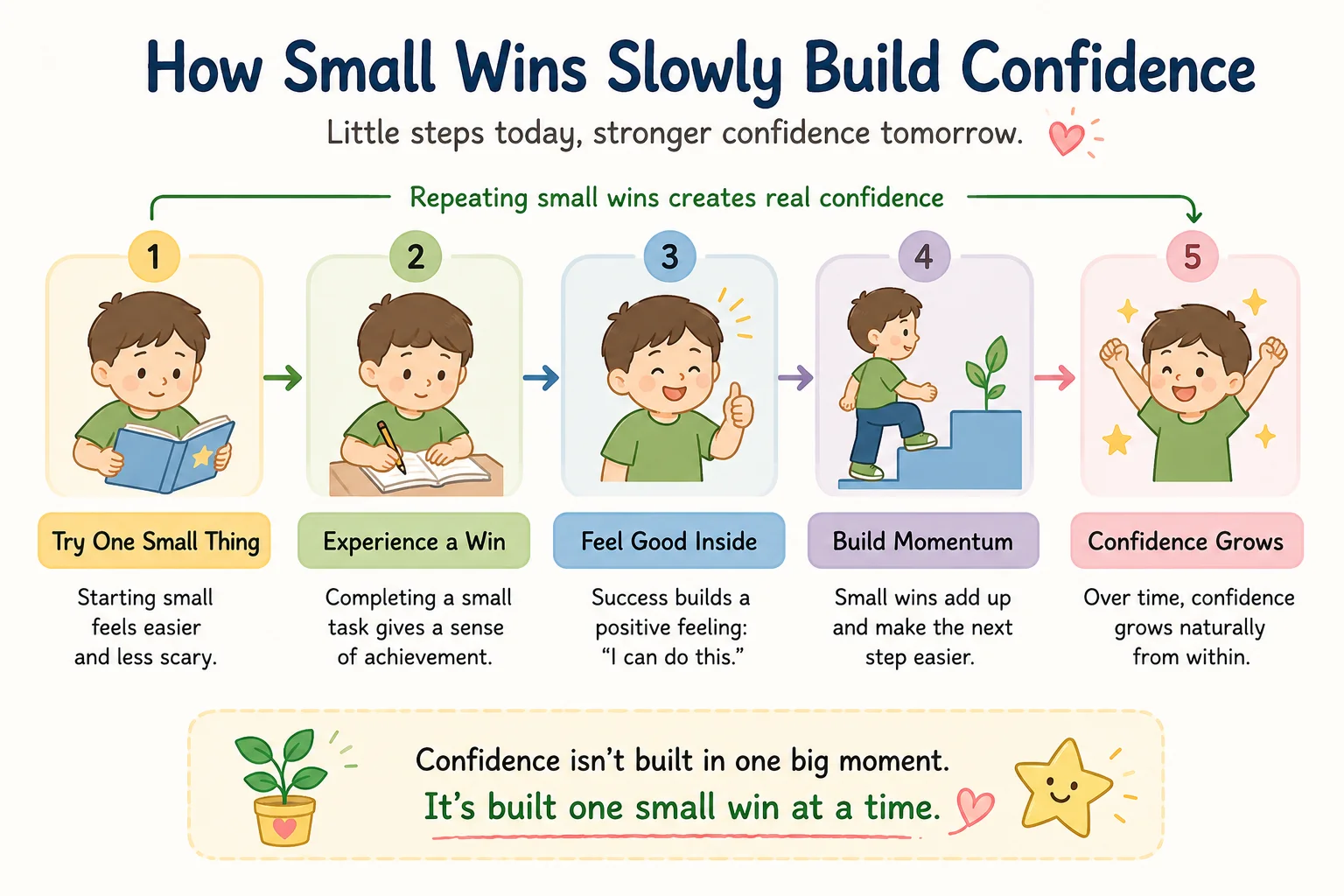
Many children do not suddenly become confident learners overnight. Confidence usually grows from repeated moments where children realise, “I can do difficult things slowly.”
Small wins matter because they help children build emotional memory. The brain starts remembering learning as something survivable rather than stressful.
Some examples of small wins include reading one page comfortably, solving one difficult question independently, remembering yesterday’s learning, staying calm after making a mistake, or trying again without giving up immediately.
Parents sometimes overlook these moments because they seem small. But children often build confidence through consistency rather than dramatic breakthroughs.
This is also why shorter learning periods can help certain children emotionally regulate better during study time. Our article on Why Short Study Sessions Work Better for Some Children explains why some learners focus better when pressure feels lighter and more manageable.
Focus More on Emotional Safety Than Constant Praise
Many parents try to build learning confidence by praising children constantly. Encouragement is important, but some children become uncomfortable when every learning moment feels heavily evaluated.
Instead of always saying “Good job” or “You’re so smart,” some children respond more calmly to observational language that notices effort without turning learning into a performance.
| Common Praise | Calmer Confidence-Building Language |
|---|---|
| “You’re so smart.” | “You stayed with that problem longer today.” |
| “Good job.” | “I noticed you kept trying even when it became frustrating.” |
| “See, that was easy.” | “That looked difficult at first, but you found a way through it.” |
| “You got them all right.” | “You checked your thinking carefully.” |
This type of language can feel emotionally safer because it focuses on experience rather than performance identity. Children who fear failure sometimes become anxious when labelled “smart,” because they begin worrying about losing that identity.
Let Learning Feel Human Instead of Constantly Measured
In some homes, learning slowly starts feeling like a permanent test. Grades, corrections, timed work, comparisons, and performance tracking can make children emotionally tired.
Sometimes confidence improves when learning becomes more human again. This could mean reading together casually, talking about interesting questions, letting children explain ideas imperfectly, laughing gently during mistakes, or allowing unfinished thoughts without immediate correction.
Learning confidence grows differently when children feel allowed to explore instead of constantly proving themselves.
This is especially important for quiet or cautious learners who may already doubt themselves internally. Our article on Why Quiet Children Sometimes Doubt Their Learning Ability explores how quieter children can sometimes hide uncertainty behind silence.
Practical Ways to Build Learning Confidence Without Rewards
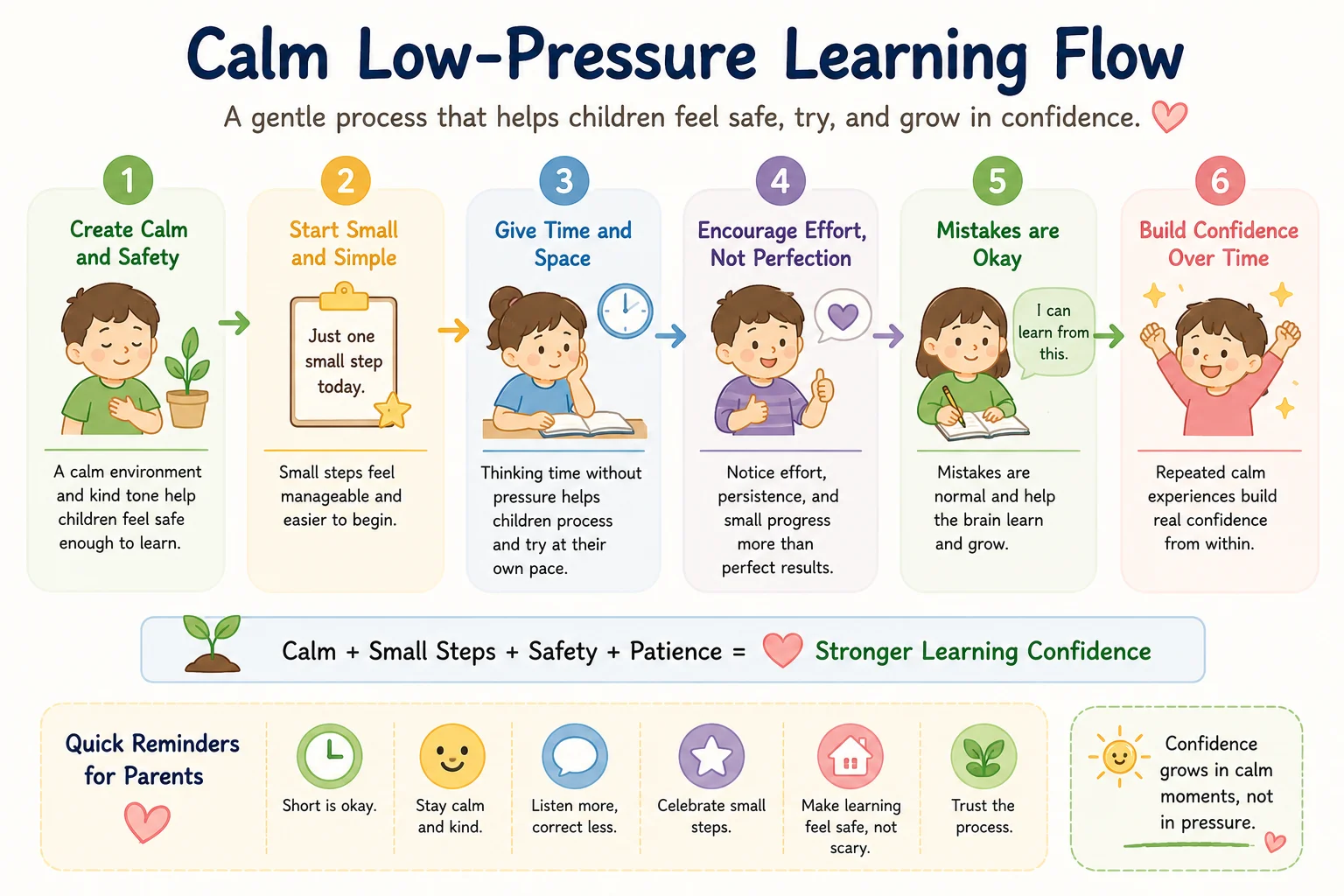
Many families find confidence-building becomes more realistic when pressure reduces slightly across everyday routines. These small changes do not need to happen perfectly. They are simply gentle ways to make learning feel safer and more manageable.
- Use shorter learning sessions when your child feels tired or overloaded.
- Allow thinking time before giving corrections or answers.
- Notice effort, patience, and persistence more than speed.
- Give small choices, such as which task to start with first.
- Create a quieter space away from noise when possible.
- Treat mistakes as part of learning, not as proof of ability.
- Read or learn together without turning every moment into a test.
- Avoid comparing siblings, even casually.
Common Mistakes That Can Accidentally Reduce Confidence
Most parents do these occasionally, especially during stressful weeks. This is not about blame. It is simply about noticing patterns that may increase emotional pressure without meaning to.
- Correcting every small mistake immediately.
- Turning all learning into performance.
- Comparing progress between siblings.
- Expecting motivation to look the same in every child.
- Using rewards as the only motivation tool.
- Pushing long study sessions when a child is mentally exhausted.
Children often remember the emotional atmosphere around learning more strongly than the exact lesson itself.
Different Children Build Confidence Differently
Some children need reassurance before they attempt new learning. Others prefer independence and become frustrated when adults help too quickly.
Highly emotional children may need calmer environments before confidence appears outwardly. Energetic children may learn better while moving, talking, or taking breaks. Quiet children may understand more than they verbally show.
This is why rigid parenting systems often fail in real households. Children do not all respond to learning emotionally in the same way.
Confidence also develops unevenly. A child may feel confident reading but insecure with maths. They may participate confidently at home but feel anxious at school. That inconsistency does not automatically mean something is wrong.
Family and Seasonal Context Matters Too
Certain times of the year naturally affect learning confidence more than parents sometimes realise. Confidence can dip during exam periods, end-of-term fatigue, darker winter routines, busy family schedules, school transitions, or emotionally overwhelming weeks.
Children who normally cope well may suddenly become more resistant, sensitive, or discouraged. This does not always mean motivation has disappeared. Sometimes the child simply needs emotional recovery time before confidence returns gradually again.
Jolyti Note: I’ve noticed some children become more open to learning when adults stop trying to “fix” motivation immediately. In many homes, confidence seems to grow more quietly when children feel emotionally safe enough to struggle imperfectly without feeling constantly evaluated.
Frequently Asked Questions
Can children stay motivated without rewards?
Yes, many children can gradually develop internal motivation over time. Emotional safety, curiosity, repeated small successes, and feeling capable often become stronger long-term motivators than constant rewards alone.
What if my child already expects rewards for everything?
This is more common than many parents think. Sudden removal of all rewards can sometimes create frustration, so gradual changes often feel easier emotionally. Parents can slowly shift attention toward effort, problem-solving, curiosity, and emotional resilience instead.
Does praise still matter?
Encouragement still matters deeply. The difference is that some children respond better when encouragement feels calm, observational, and supportive rather than heavily performance-focused.
Why does my child lose confidence after small mistakes?
Some children experience mistakes very emotionally, especially if they already fear disappointment or comparison. Building emotional safety around mistakes can help children recover confidence more steadily over time.
How long does learning confidence take to build?
Usually longer than parents hope, but often in healthier ways than expected. Confidence tends to grow gradually through many repeated experiences rather than one major breakthrough.
Final Thoughts
Building learning confidence without rewards does not mean parents must create perfect routines or remove every struggle from learning. In many homes, confidence develops slowly through calmer moments, emotional safety, manageable challenges, and repeated experiences of trying again.
Children do not all show confidence loudly. Some grow quietly. Some need more reassurance. Some need smaller steps. Others simply need learning to feel less emotionally heavy.
What matters most is not perfection, but creating an atmosphere where children feel safe enough to keep learning imperfectly over time.
Featured image is AI-generated and intended for illustrative purposes only.
Leave a Reply