
Many parents notice the same pattern during homework time. A child sits down, opens their book, and within a few minutes they are looking around the room, playing with a pencil, asking unrelated questions, or getting up again.
Why children get distracted during homework so easily often comes down to tiredness, emotions, home environment, pressure, and how each child naturally handles focus after a long day. Distraction does not always mean laziness, lack of ability, or poor motivation.
This can feel confusing because children may focus well on games, toys, stories, or things they enjoy, but then struggle to stay with homework. In real homes, homework often happens when children are already tired and parents are already busy.
This article explains why children get distracted during homework so easily in a calm and realistic way. The goal is not to blame parents or children. The goal is to help families understand what may be happening underneath the behaviour.
Real Family Learning Reality Check
In many homes, homework does not happen in a quiet study room with unlimited time and energy. It happens after school, after travel, after activities, near siblings, around dinner, and sometimes while parents are trying to manage many things at once.
A child may come home after listening, sitting still, following instructions, solving problems, and managing friendships all day. By the time homework starts, their attention may already feel stretched.
This is why homework distraction can appear even when a child is bright, curious, and capable. The child may still be able to learn, but the timing, mood, environment, or emotional load may make focus harder in that moment.
Real learning happens inside real family life. It is often messier than advice online makes it sound.
What Most Parenting Advice Misses
Many homework tips focus on removing distractions, building routines, or making children sit still until the work is done. These ideas can help some families, but they do not always explain why the distraction is happening.
Some children are not distracted because they do not care. They may be mentally tired, emotionally full, worried about mistakes, overstimulated, or unsure how to begin.
In busy homes, focus is not always created by stricter rules. Sometimes it grows when the child feels calmer, safer, and less rushed. That does not mean homework becomes easy, but it can make starting and staying with the task feel more possible.
Why Homework Distractions Happen
A simple visual can help parents see that homework distraction is usually not caused by one single thing. It is often a mix of tiredness, emotions, pressure, learning style, and the home environment.
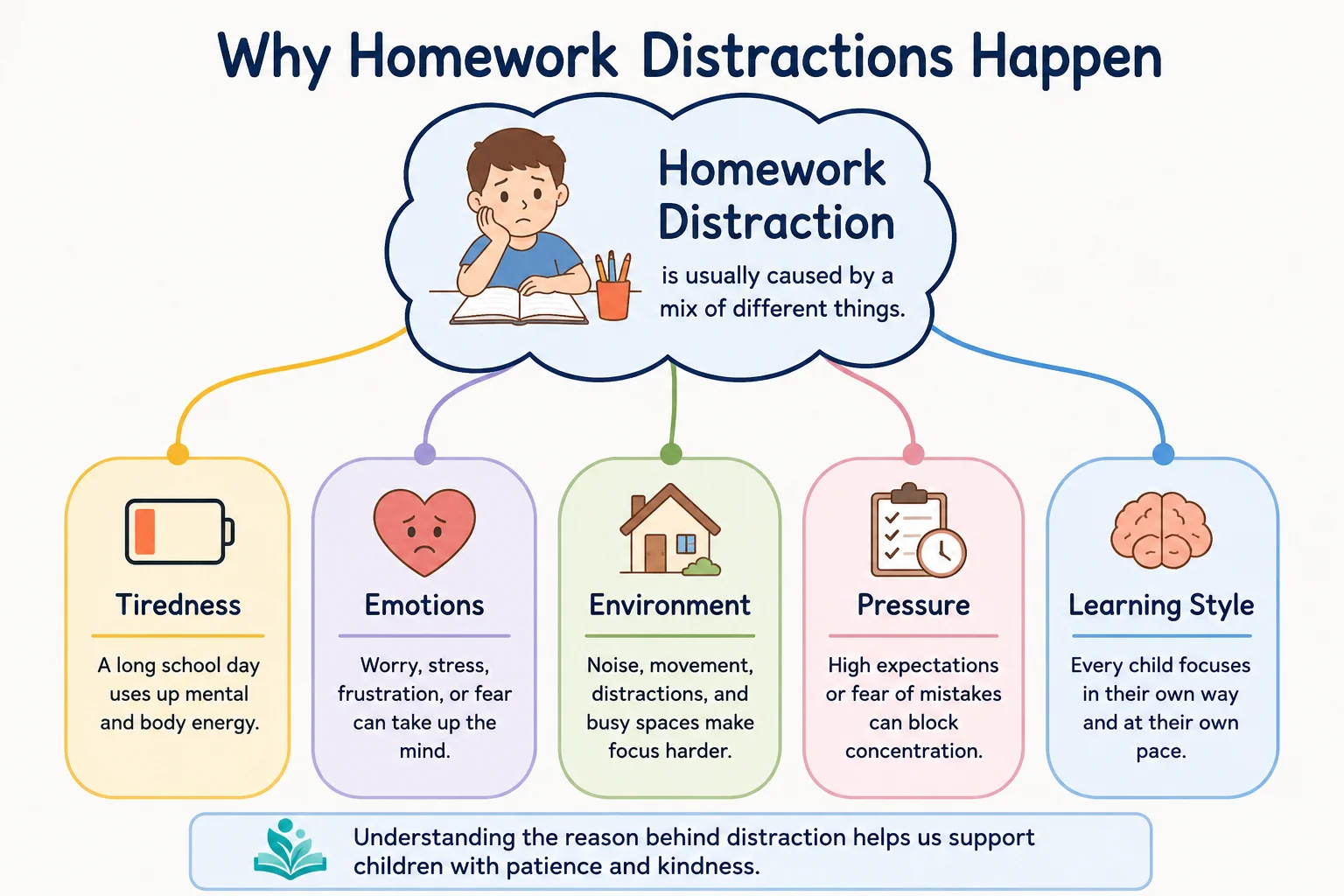
This diagram can show homework distraction in the centre, with simple branches such as tiredness, emotions, environment, pressure, and learning style. It gives parents a quick way to understand the bigger picture before trying to solve the behaviour.
Some Children Use Their Attention Differently
Not all children focus in the same way. Some children sit still and look focused. Others move often, ask questions, look away, or pause before returning to the task.
A child who appears distracted may still be thinking. They may be processing the task slowly, taking in background sounds, or moving between ideas before settling back into the work.
This is one reason children in the same family can respond very differently to the same homework situation. One child may need silence. Another may think better with soft background noise or short movement breaks.
Different Children, Different Focus Patterns
This visual can help parents remember that focus does not always look the same from the outside.
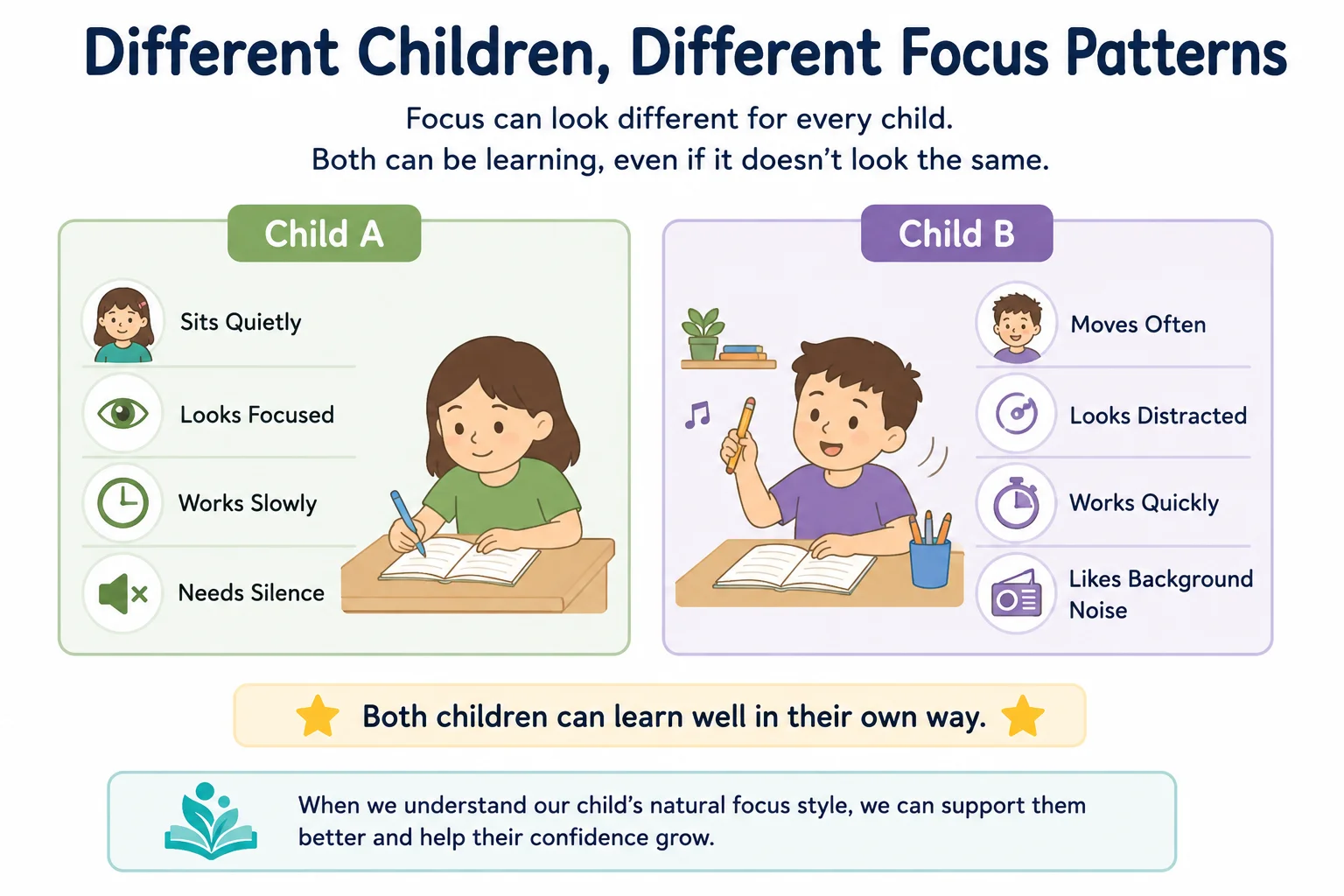
This diagram can compare two children side by side. One may sit quietly and work slowly. Another may move often but still understand the task. The main message is simple: different focus patterns can still lead to learning.
After-School Mental Fatigue Is Often Invisible
Adults can usually notice when a child is physically tired. Mental tiredness can be harder to see.
School asks children to concentrate for many hours. They need to listen, remember, wait, answer, share, read, write, solve, and manage emotions. Even a normal school day can use a lot of attention.
By homework time, some children may still look energetic, but their thinking energy may be low. This can make simple tasks feel bigger than they are.
This may also explain why homework is easier on some days and harder on others. The homework may not have changed, but the child’s available energy may have changed.
What Happens Before Homework?
A timeline visual can help parents see why a child may already feel full before homework begins.
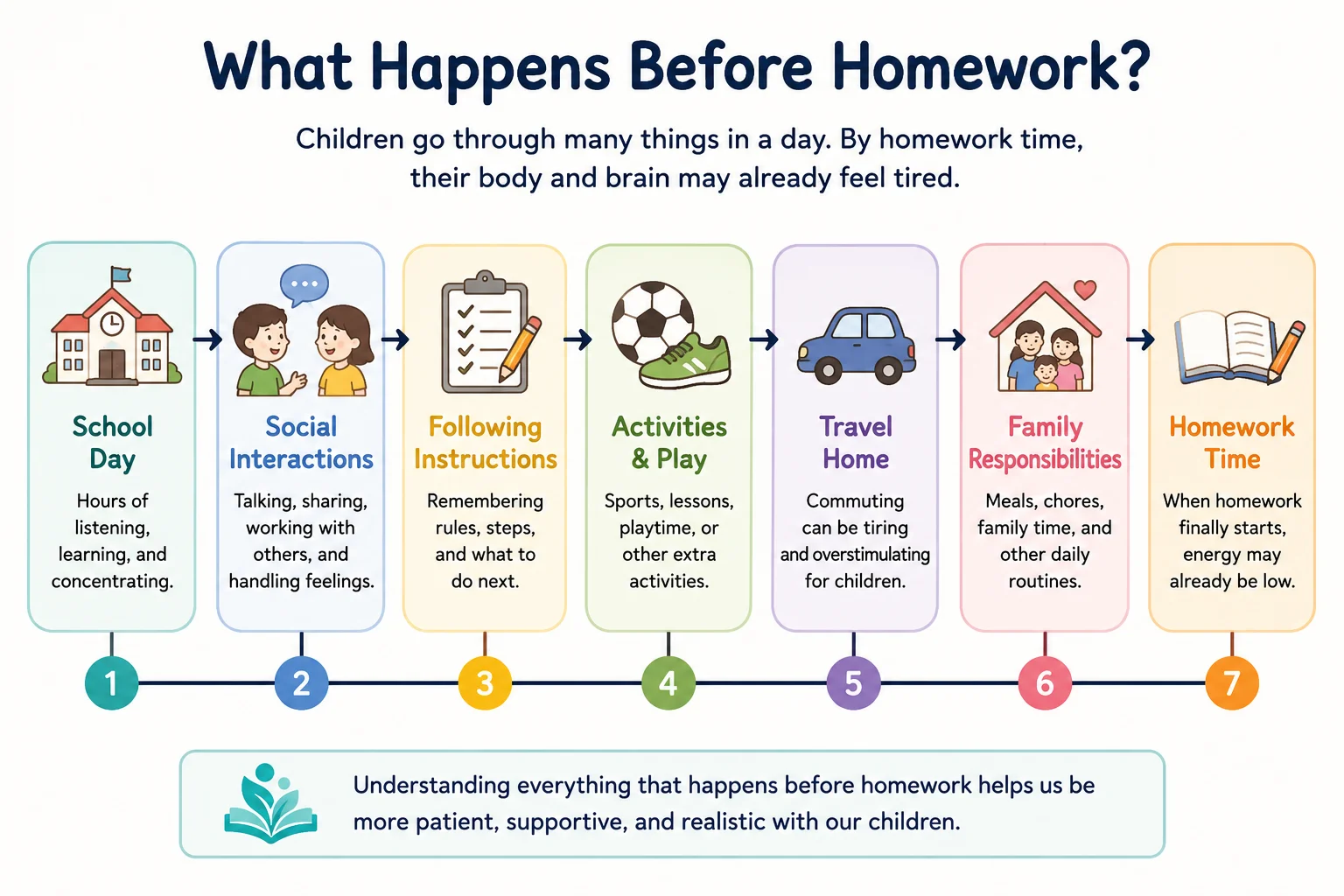
This diagram can show a simple path from school day, social interactions, instructions, travel home, activities, family time, and then homework. It helps explain why distraction may be connected to everything that happened before the homework session.
Emotional Distractions Often Look Like Attention Problems
Not every distraction comes from noise, toys, or screens. Sometimes the distraction is happening inside the child.
A child may worry about getting answers wrong. They may feel unsure before they start. They may not want a parent to see them struggle. These feelings can take up space in the mind and make concentration harder.
When emotions are high, a child may appear restless, forgetful, silly, or uninterested. Underneath, they may simply be trying to avoid an uncomfortable feeling.
If your child often worries about mistakes during learning, you may also find Signs a Child Is Afraid of Getting Answers Wrong helpful, because it explains how fear of mistakes can quietly affect learning behaviour.
The Home Environment Feels Different From School
Many parents wonder why their child can focus at school but gets distracted during homework at home. The difference is often the environment.
School is mainly built around learning. Home is built around many things at once. It is a place for meals, rest, play, family conversations, devices, chores, and comfort. Switching into learning mode at home can take more effort than adults expect.
| School Environment | Home Environment |
|---|---|
| More consistent routines | Many activities happening at once |
| Learning-focused spaces | Mixed-use spaces for rest, play, meals, and study |
| Clear classroom expectations | More flexible family expectations |
| Fewer personal distractions | More familiar distractions nearby |
| Teacher-led learning time | Parent-supported learning during busy hours |
This does not mean home is a bad place for learning. It simply means home learning has different challenges. Families interested in this topic may also find Why Homework Feels Harder at Home Than at School helpful.
Some Children Need Movement to Think
Many adults imagine focus as sitting still, staying quiet, and looking at the page. Some children do focus that way. Others do not.
A child who taps a pencil, stretches, changes position, or walks briefly may not be trying to avoid learning. For some children, small movement helps them stay connected to the task.
This does not mean every movement helps focus. It simply means movement is not always the enemy of attention. Sometimes the goal is not perfect stillness, but a calmer way back to the task.
Too Much Pressure Can Create More Distraction
Pressure can make homework distraction worse. When children feel watched, rushed, or judged, part of their attention may move away from the task and toward worry.
A child may start thinking, “What if I get it wrong?” or “What if this takes too long?” These thoughts can make the task feel heavier.
This can create a difficult cycle. Distraction leads to frustration. Frustration leads to pressure. Pressure makes it harder to focus. Many families experience this cycle without meaning to.
For a calmer look at this topic, How to Help Children Stay Focused Without Pressure may connect naturally with what many parents see during homework time.
Practical Insights for Parents
Homework distraction can feel easier to understand when parents look at the whole situation, not only the behaviour. Small changes may help some children feel more settled without turning homework into a strict system.
- Some children focus better after a short transition after school.
- Mental tiredness can affect focus even when a child looks energetic.
- Emotional worries may appear as distraction, delay, or silliness.
- Some children need quiet, while others manage better with gentle background sound.
- Shorter homework starts can feel safer than long pressured sessions.
- Focus often grows when children feel less afraid of mistakes.
These are not strict rules. They are gentle patterns that families can adjust depending on the child, the homework, and the day.
Common Misunderstandings About Homework Distraction
Homework distraction is easy to misunderstand, especially when parents are tired or worried about school progress.
- Being distracted does not always mean a child is lazy.
- Needing breaks does not always mean poor motivation.
- Slow homework progress does not always mean low ability.
- Daydreaming is not always a sign of disinterest.
- Strong emotions can affect focus more than adults may realise.
- Different siblings may need different types of support.
When parents understand the possible reasons behind distraction, homework time can feel less like a battle and more like a learning moment that needs support.
Family and Seasonal Context
Homework distraction often becomes more noticeable during busy periods. Near the end of a school term, during assessment weeks, after holidays, or during family changes, children may have less emotional and mental energy available.
This does not always mean something serious has gone wrong. It may simply mean the child is carrying more than usual. In those seasons, small learning moments may be more realistic than expecting perfect focus every afternoon.
Jolyti Note: I’ve noticed that children who seem distracted are not always struggling with learning itself. Sometimes they are carrying more mental or emotional activity than adults can see.
“`Every child shows tiredness, stress, and focus challenges differently. This is one reason articles like Why Homework Feels Harder at Home Than at School can help parents see the learning environment with more understanding.
“`Frequently Asked Questions
Is it normal for children to lose focus during homework?
Yes. Many children lose focus during homework, especially after a long school day. Attention naturally rises and falls, and homework often happens when children are already tired.
Does homework distraction mean my child has a learning problem?
Not always. Distraction can come from tiredness, emotions, environment, pressure, or learning style. If distraction is constant, severe, or affecting daily life, parents may choose to speak with the child’s teacher or a trusted professional for more guidance.
Why can my child focus on games but not homework?
Games often provide quick feedback, colour, movement, rewards, and choice. Homework usually needs slower effort and delayed results. That difference can make homework feel harder to stay with.
Can worry make a child distracted during homework?
Yes. Worry about mistakes, grades, or disappointing others can make concentration harder. Some children show this worry by delaying, moving around, asking unrelated questions, or avoiding the task.
Will my child’s focus improve over time?
For many children, focus improves gradually as confidence, maturity, and self-awareness grow. Progress may be slow and uneven, but small calm learning moments can still matter.
Final Thoughts
Why children get distracted during homework so easily is often more complex than it first appears. Distraction can be shaped by tiredness, emotions, pressure, learning style, and the difference between school and home.
Most importantly, distraction does not define a child’s ability to learn. It may be a signal that the child needs a calmer start, a smaller first step, or more understanding of what makes focus difficult for them.
Learning confidence rarely grows in a perfect straight line. Some days will be smoother than others. In real families, even small moments of calm support can help children feel safer, more understood, and more able to return to learning.
Featured image is AI-generated and intended for illustrative purposes only
Leave a Reply