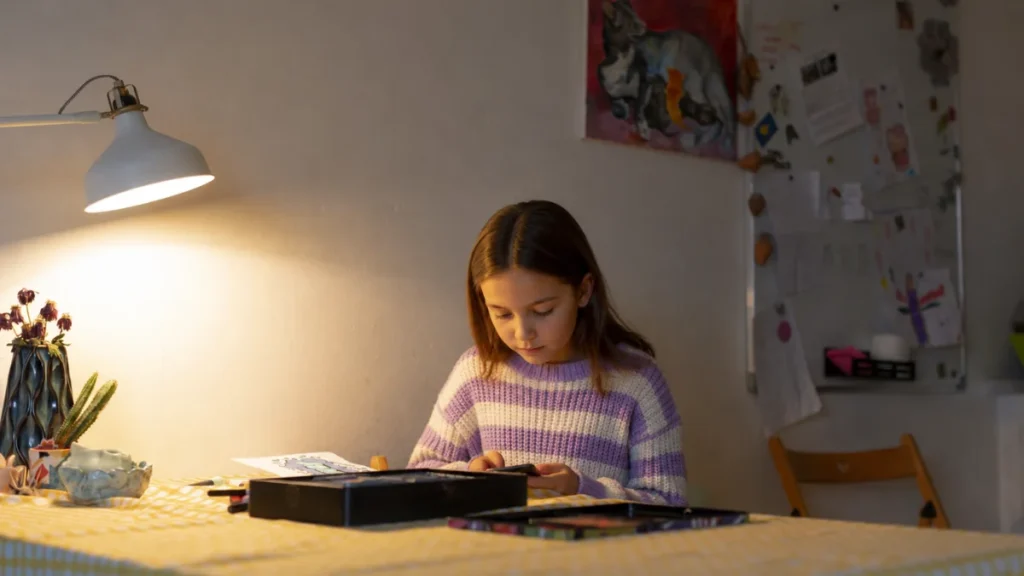
Many parents search for this after another homework moment that felt harder than expected. A child may start well, then suddenly stare at the page, wiggle in the chair, ask for snacks, become upset, or say they cannot do it anymore. In busy homes, it can be hard to know whether a child needs a break or is simply avoiding homework.
For many young children, homework breaks often work best when they are short, calm, and predictable. A helpful starting point is usually a 5-minute break after about 10 to 20 minutes of homework, depending on the child’s age, energy, mood, and how demanding the task feels.
This can feel confusing because children do not always show tiredness clearly. Some children still look active, talkative, or playful, even when their learning energy is low. Others may seem distracted when they are actually overwhelmed, bored, worried about mistakes, or mentally tired from the school day.
This article will help explain how long homework breaks should be for young children, why some children need breaks more often than others, and how families can use breaks in a calm, realistic way without turning homework into a strict system.
Why Homework Breaks Look Different in Real Homes
In real homes, homework rarely happens in a quiet, perfect space. Parents may be cooking, answering messages, helping another child, cleaning up, or trying to get through the evening without everyone becoming upset. Children may also be tired from school, hungry, overstimulated, or emotionally full from the day.
This is why homework breaks cannot be judged only by the clock. A child who had a calm school day may manage a longer homework session. A child who had a noisy, emotional, or socially tiring day may need a break much sooner.
Some children also need breaks because the home environment feels different from school. At school, routines are clear and everyone is working. At home, homework can feel more personal. A child may feel watched, corrected, rushed, or worried about disappointing a parent.
These feelings do not mean parents are doing something wrong. They simply show that learning at home has an emotional side. Homework breaks can help when they give the child a small reset before frustration becomes too big.
What Most Homework Break Advice Misses
Many homework tips make breaks sound like a simple reward: work first, then play. That can work for some children, but it does not explain what breaks are really doing for younger learners.
For many young children, homework breaks are not only about motivation. They are about emotional recovery, attention reset, body movement, and helping the brain return to the task without feeling trapped.
Some children do not stop because they are lazy. They stop because their brain is tired of holding focus. Others stop because they feel nervous about mistakes. Some children stop because sitting still after a long school day feels too hard for their body.
This is why the best homework breaks are usually not wild, long, or highly exciting. They are small pauses that help the child feel steady enough to continue.
How Long Should Homework Breaks Be for Young Children?
For many young children, a 5-minute homework break after 10 to 20 minutes of focused work is a calm and realistic starting point. Younger children, tired children, or children who become emotional quickly may need breaks closer to the 10-minute mark. Children who are settled and confident may manage closer to 20 minutes before needing a pause.
The break itself usually does not need to be long. In fact, long breaks can sometimes make it harder for children to return to homework. Once a child fully switches into play, screens, or a different activity, coming back to homework may feel like starting all over again.
A short homework break works best when it gives the child relief without pulling them completely out of learning mode. The goal is not to make homework feel strict. The goal is to keep the task small enough that the child does not feel overwhelmed.
A Calm Homework Rhythm for Young Children
A simple homework rhythm can help parents see that breaks are a normal part of learning, not a sign that the child is failing. Young children often learn better when their focus time is short enough to feel possible.
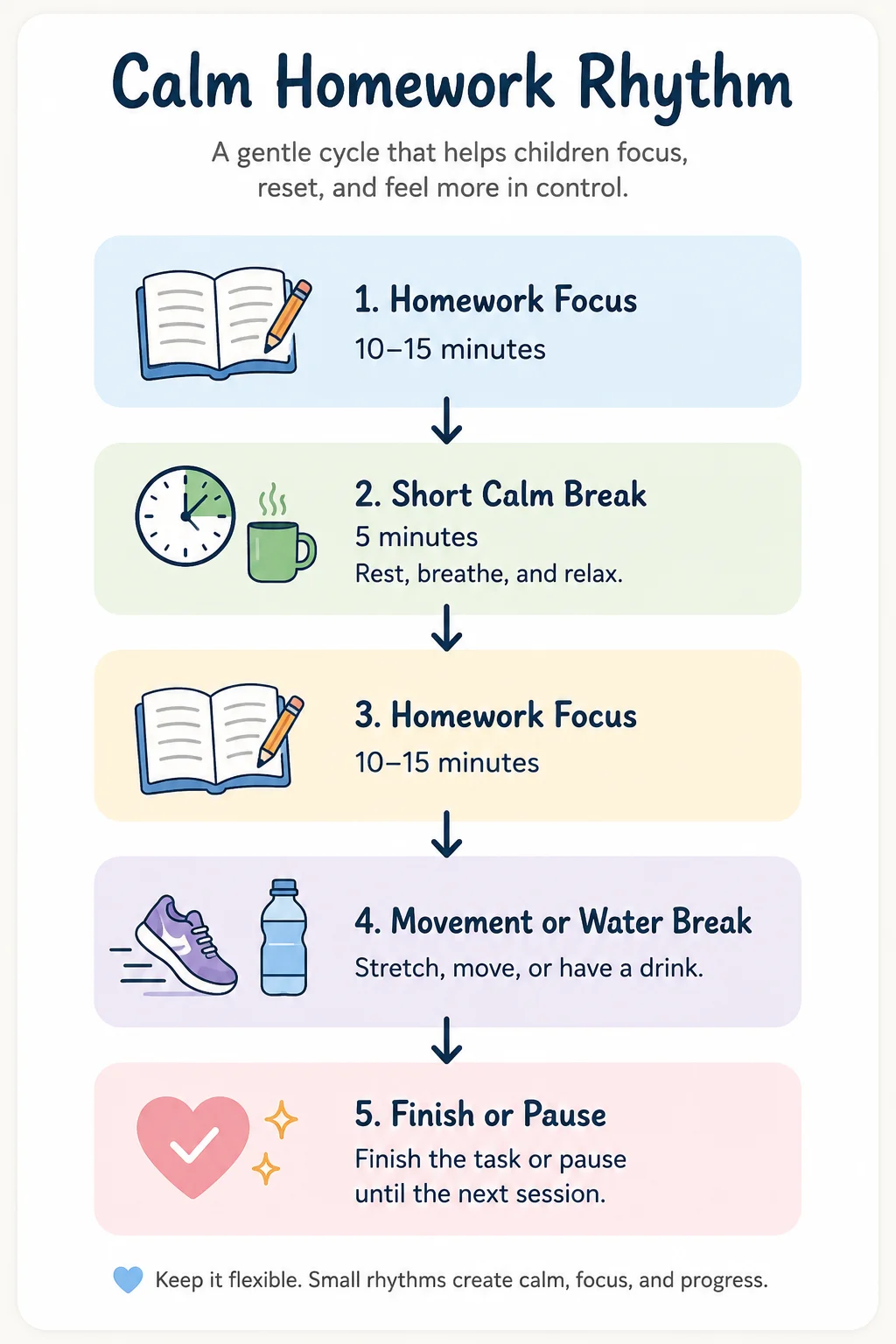
This type of rhythm can feel less scary for children because homework does not look endless. It also helps parents notice that shorter focus periods can still be productive, especially when they protect the child’s confidence and emotional energy.
If your child often struggles with longer homework sessions, you may also find this related article helpful: Why Short Study Sessions Work Better for Some Children.
Why Shorter Breaks Often Work Better
Shorter breaks often work better because young children can lose the homework connection quickly. A 5-minute break may help them breathe, move, drink water, or reset their feelings. A 20-minute break may quietly become a full stop.
This does not mean longer breaks are always wrong. Some children need a bigger pause after a hard school day. But when the goal is to return to homework soon, shorter breaks are usually easier to manage.
Short breaks also reduce the emotional struggle of restarting. The child does not feel as if they are leaving fun behind and returning to something heavy. Instead, homework becomes a pattern of small efforts and small resets.
Calm Breaks vs Overstimulating Breaks
Not every break helps the brain in the same way. Some breaks calm the child down, while others make it harder to restart. This is especially true when a child is already tired or emotionally sensitive after school.
Screens, fast games, loud videos, and very exciting play can sometimes make homework feel harder afterward. These activities are not “bad,” but they may pull the child too far away from the calm focus needed for homework.
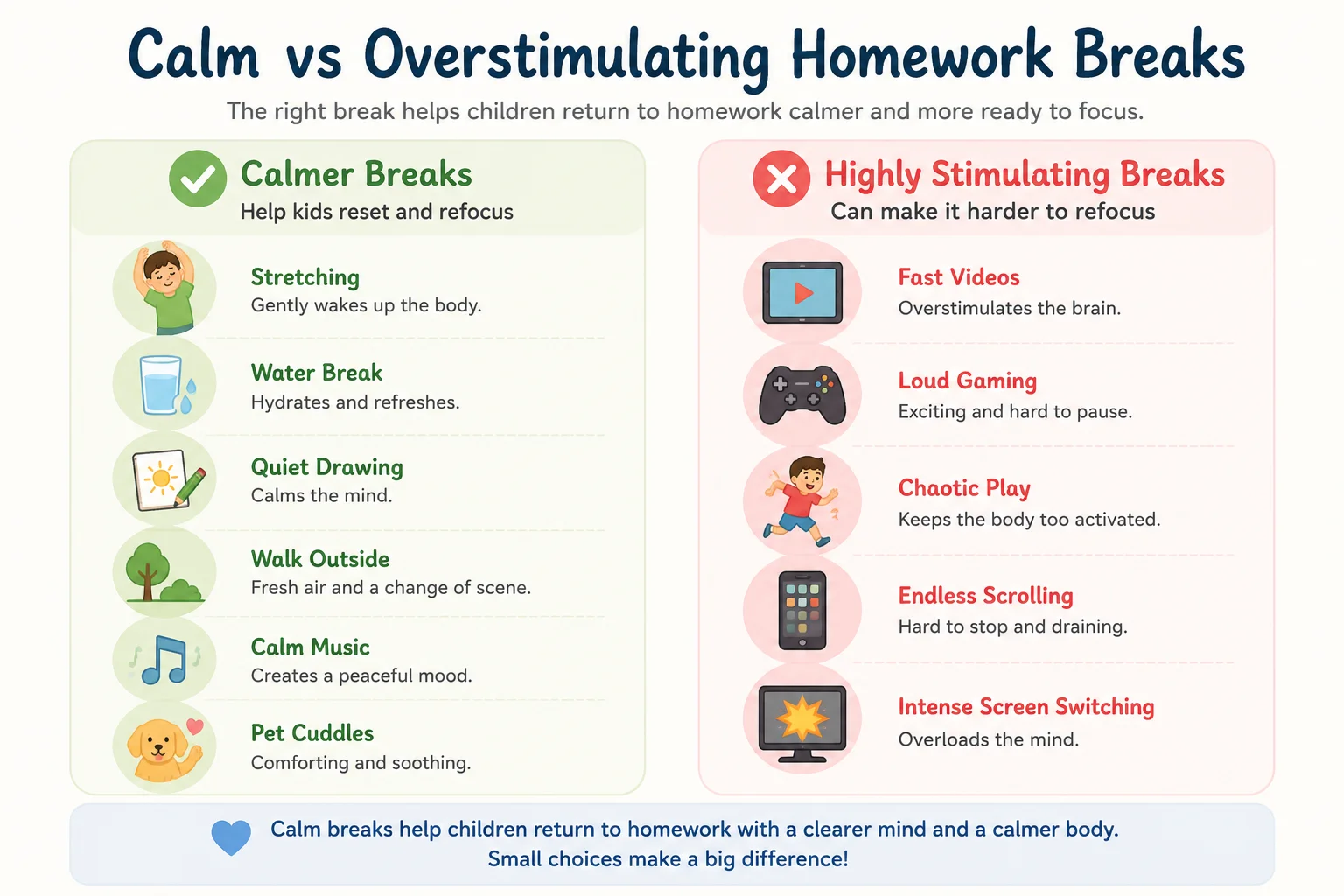
Calmer breaks are often more useful because they give the child’s brain a rest without making the next homework step feel too difficult. A child may come back more easily after stretching, drinking water, walking around the room, cuddling a pet, or quietly drawing for a few minutes.
Signs a Child May Need a Homework Break
Children do not always say, “I need a break.” Their behaviour often says it first. A child may still want to do well, but their attention and emotions may be running low.
| What Parents May Notice | What It May Actually Mean |
|---|---|
| Fidgeting or moving constantly | The child’s body may need movement before the brain can focus again |
| Staring at the page | Attention may be fading, even if the child understands the work |
| Getting upset over small mistakes | Emotional overload may be building |
| Asking unrelated questions | The child may be trying to escape the pressure of the task |
| Rushing answers | The child may want the uncomfortable feeling to end quickly |
| Saying “I can’t do this” | Confidence may be dropping, not just focus |
This table is not meant to label every behaviour. It simply helps parents pause before assuming the worst. Sometimes a child’s behaviour is asking for support before their words can explain it.
If mistakes often lead to big emotions in your home, this related article may connect naturally: How to Help a Child Who Gets Upset After Small Mistakes.
Different Children Need Different Breaks
Some children need quiet breaks. Others need movement. Some need a parent nearby for emotional safety, while others calm down better with a few minutes of space. This is why one homework break routine may work beautifully for one child and poorly for another.
A quiet child may not complain, but may slowly shut down. A more expressive child may cry, argue, or push the book away. Both children may need a break, but their signals look different.
Children who worry about getting answers wrong may need breaks that lower pressure. Children who are physically restless may need breaks that let their body move. Children who are tired may need breaks that feel peaceful rather than exciting.
The most helpful question is not always, “How do I make my child keep going?” Sometimes it is, “What kind of break helps my child come back feeling safer?”
Practical Insights for Busy Families
Many families do not need a perfect homework break routine. A simple pattern is often enough. The break can be short, gentle, and easy to repeat without making the evening more complicated.
Some children respond better when the break is named calmly before homework begins. For example, knowing there will be a short pause after one small section can make the task feel less endless.
A Gentle Homework Timer Idea: Some children feel calmer when homework has a clear beginning and ending point. Short timed study sessions can sometimes make learning feel smaller and more manageable instead of endless.
For families who want a gentle option, the free StudentTimer website includes calm study sessions with built-in breaks designed for shorter focus periods and quieter homework routines.
Other children feel calmer when only one part of the homework is visible at a time. This can make the work feel smaller and easier to return to after a break.
For children who often struggle after school, homework may also feel easier when the whole routine starts softly. This related article may be useful here: How to Make Homework Feel Less Stressful After School.
Common Misunderstandings About Homework Breaks
Homework breaks can be misunderstood because adults often view them through productivity. But young children are still learning how to manage attention, emotions, tiredness, and effort.
Needing breaks does not mean a child is lazy. Losing focus does not mean a child is not smart. Wanting movement does not always mean a child is being difficult. Becoming emotional does not always mean the work is too hard academically.
Sometimes homework breaks protect confidence because they stop frustration from growing too large. When a child returns after a calm break, they may feel more willing to try again.
The goal is not to remove all struggle. Some struggle is part of learning. The goal is to stop the struggle from becoming so heavy that the child begins to feel unsafe, incapable, or defeated.
Family and Seasonal Context
Homework breaks may need to change during different seasons of family life. During busy school terms, children may become tired faster. After holidays, they may need time to adjust back into routine. Near the end of term, small homework tasks may feel bigger because the child’s emotional energy is already low.
Evenings can also feel harder when families are rushed, when siblings are noisy, when dinner runs late, or when parents are tired too. In these moments, a calm break may help everyone breathe before homework turns into an argument.
Jolyti Note: I’ve noticed that some children do not need long homework breaks as much as they need gentler transitions. Every child is different, but many seem to return more easily when the break feels calm rather than exciting. In real homes, small pauses can sometimes protect the mood of the whole evening.
Frequently Asked Questions
How long should homework breaks be for young children?
For many young children, a 5-minute break after 10 to 20 minutes of homework is a helpful starting point. Some children may need breaks sooner if they are tired, emotional, restless, or overwhelmed.
Are longer homework breaks better?
Not always. Longer breaks can sometimes make it harder for children to restart homework. Short, calm breaks often work better when the child needs a quick reset but still needs to return to the task.
Should screen time be used as a homework break?
Screen time may work for some children, but it can also make restarting harder because it is highly stimulating. Many young children return more calmly after water, movement, quiet drawing, stretching, or a short walk around the home.
What if my child refuses to come back after a break?
This can happen when the break is too long, too exciting, or when homework already feels emotionally heavy. A shorter break and a smaller next task may make returning feel easier.
Does needing homework breaks mean my child has poor focus?
Not necessarily. Young children are still building attention, emotional control, and learning stamina. Needing breaks can be a normal part of learning, especially after a long school day.
Final Thoughts
Homework breaks are not a sign that young children are failing. In many homes, they are a small way to protect focus, confidence, and emotional steadiness during a part of the day that can already feel full.
For many young children, short and calm homework breaks work better than long or exciting ones. A few minutes of movement, water, quiet breathing, or gentle reset can sometimes help a child return with less resistance.
Real families do not need perfect homework routines. Children are still learning how to manage effort, tiredness, mistakes, and emotions. When breaks are used with calm understanding, homework can begin to feel less like a battle and more like something the child can slowly learn to manage.
Featured image is AI-generated and intended for illustrative purposes only.
Leave a Reply