
Some children come home from school and need quiet before they can even think about homework. They may sit alone, avoid talking, stare at the wall, lie on the couch, or move slowly from one thing to another. To a busy parent, this can look like delaying, ignoring homework, or refusing to cooperate.
Why some children need quiet before homework time often comes down to mental and emotional recovery. After a full school day, some children need a calm pause before their brain feels ready to focus on another learning task at home.
This can feel confusing because not every child reacts the same way after school. One child may talk nonstop and start homework quickly. Another child may need silence, space, or a slow return to normal family life before they can concentrate again.
This article explains why some children need quiet before homework time, how quiet recovery is different from homework avoidance, and how parents can understand this behavior without guilt, pressure, or unrealistic routines.
Real Family Homework Reality Check
In real homes, homework rarely begins in perfect calm. Parents may be cooking dinner, answering messages, helping another child, finishing work, or managing tiredness from their own day.
Children also arrive home with their own tiredness. They may have been listening, talking, waiting, sharing, concentrating, solving problems, managing friendships, and following instructions for many hours.
By the time homework appears, it may not feel like “one small task” to the child. It may feel like one more demand after a day that was already full.
This does not mean your child is lazy. It does not mean you have failed to build good habits. It may simply mean your child needs a softer landing between school and homework.
What Most Homework Advice Misses
Many homework tips focus on starting immediately, following a strict routine, or finishing work before play. These ideas may help some families, but they do not explain every child’s behavior.
What often gets missed is transition time. Some children cannot move quickly from a noisy, social, structured school day into focused home learning. Their brain needs time to shift.
For these children, quiet before homework time is not wasted time. It can be the bridge that helps them move from school mode into home learning mode.
School Uses More Energy Than It Seems
School can look simple from the outside. Children sit, listen, write, read, answer questions, and play with friends. But inside the child’s mind, much more is happening.
A child may be trying to understand lessons, follow social rules, keep up with instructions, manage mistakes, wait for their turn, and stay calm when something feels hard.
Some children manage all of this quietly. They do not complain at school, so parents may not realize how much effort the child has already used before arriving home.
This is one reason why some children need quiet before homework time. Their body may look fine, but their mind may need a reset.
School Day Mental Energy Flow
This visual can help parents see how a child’s mental energy may slowly reduce across a school day, even when the child seems okay on the outside.
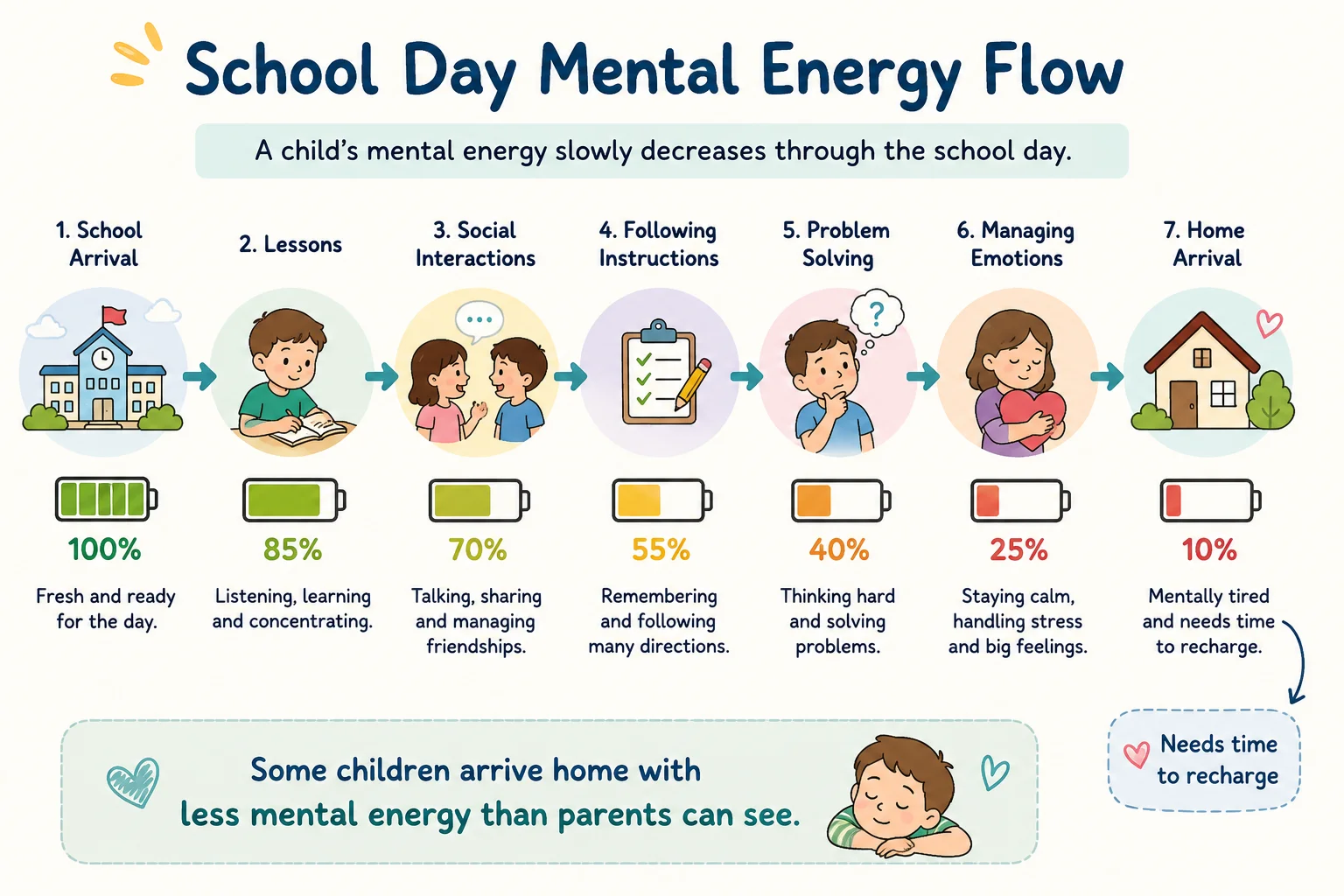
This diagram shows a calm flow from school arrival to home arrival, with mental energy slowly decreasing through lessons, social interactions, instructions, problem solving, and emotional control.
The goal of this visual is to help parents understand that homework begins after many hidden demands have already happened.
Quiet Children May Recharge Differently
Some children regain energy by talking, moving, or playing. Other children regain energy through quiet, space, and less stimulation.
A child who needs silence after school may not be unhappy. They may simply be reflective. They may need time to process the day before they can answer questions, make decisions, or focus on homework.
This can be especially true for quieter children who keep many feelings inside. They may appear calm, but they may be mentally sorting through school experiences.
If your child is quiet and sometimes unsure about learning, you may also find Why Quiet Children Sometimes Doubt Their Learning Ability helpful.
Emotional Processing Can Look Like Delay
Sometimes homework delay is not really about homework. It may be about something emotional that happened earlier in the day.
A child may be thinking about a mistake, a friendship problem, a teacher’s comment, a hard lesson, or a moment when they felt embarrassed. Even small events can feel big to a child.
When a child is still carrying those feelings, homework can feel harder to begin. Their mind may not be ready for another task because it is still busy processing the first one.
This is why some children seem fine one day and resistant the next. The homework may be the same, but the emotional load may be different.
If your child becomes upset around mistakes, How to Help a Child Who Gets Upset After Small Mistakes may connect naturally with this topic.
Quiet Recovery vs Homework Avoidance
One helpful distinction is the difference between quiet recovery and homework avoidance. They can look similar at first, but they are not always the same.
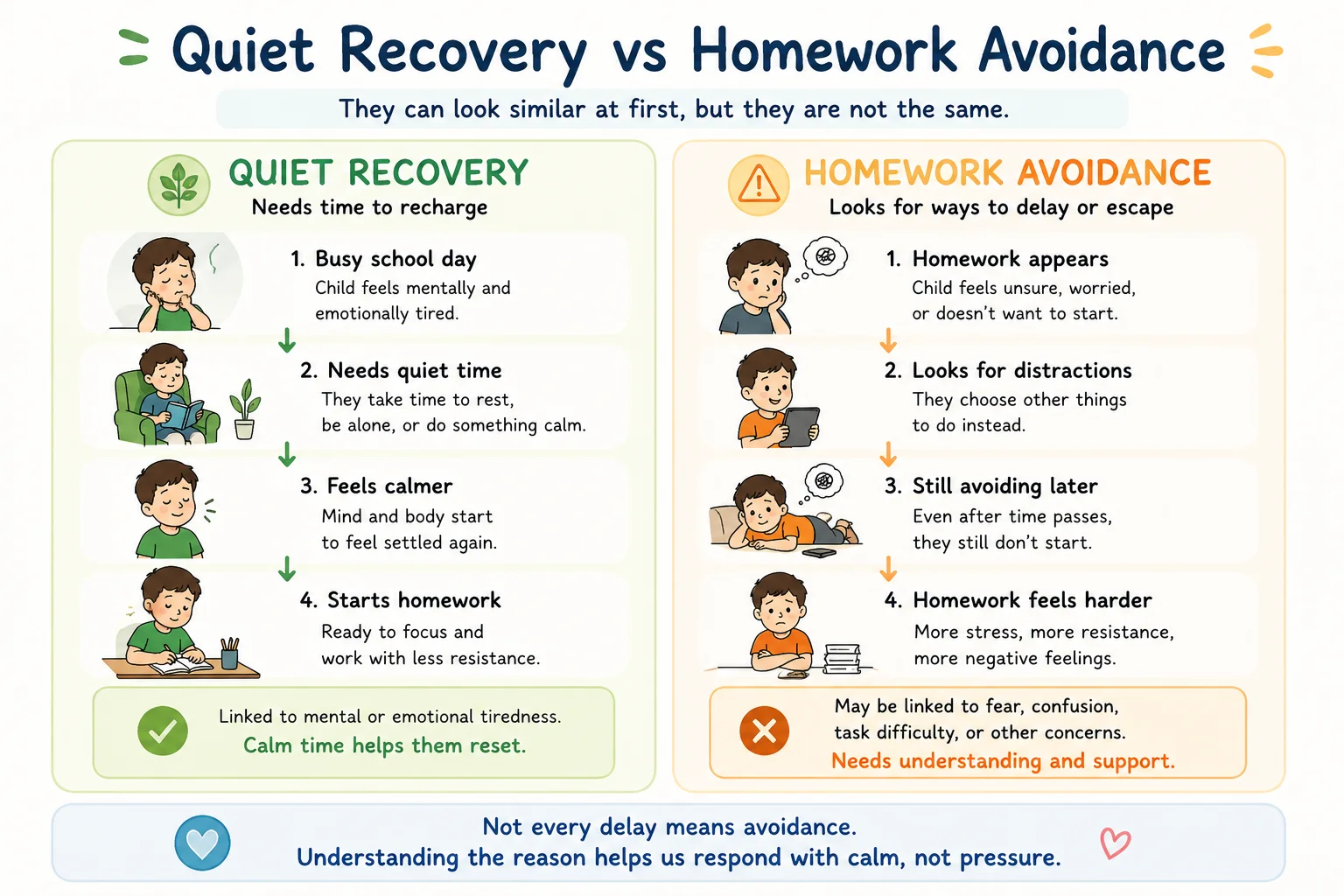
This diagram helps parents see that a quiet pause may be recovery, while longer avoidance may point to worry, confusion, or task difficulty.
| Quiet Recovery | Homework Avoidance |
|---|---|
| The child becomes calmer after some time | The child keeps resisting even after settling |
| The child may sit quietly or rest | The child may keep searching for distractions |
| Homework feels easier after a calm pause | Homework still feels impossible to begin |
| The child may need space before talking | The child may argue, delay, or avoid repeatedly |
| Often linked to mental or emotional tiredness | May be linked to fear, confusion, or task difficulty |
This table does not label children. It simply helps parents notice patterns with more calm and less frustration.
If homework often turns into conflict, How to Stop Homework from Turning into Arguments may also be useful.
Some Children Need Transition Time
Children move through many transitions each day. They move from home to school, lesson to lesson, lunch to class, school to home, and then home to homework.
Some children handle these changes quickly. Others need a slower emotional shift. They may need a snack, quiet sitting, soft play, drawing, or simply a few minutes without questions.
Transition time can make homework feel less sudden. Instead of feeling like school has followed them home, the child has a small space to breathe before learning begins again.
This connects well with How to Calm a Child Before Starting Homework, especially for families who notice tension before the first homework task even starts.
Different Children Recharge Differently
This visual can show that children do not all prepare for homework in the same way. Some children feel ready after talking. Some feel ready after quiet. Some feel ready after food, movement, or a short break.
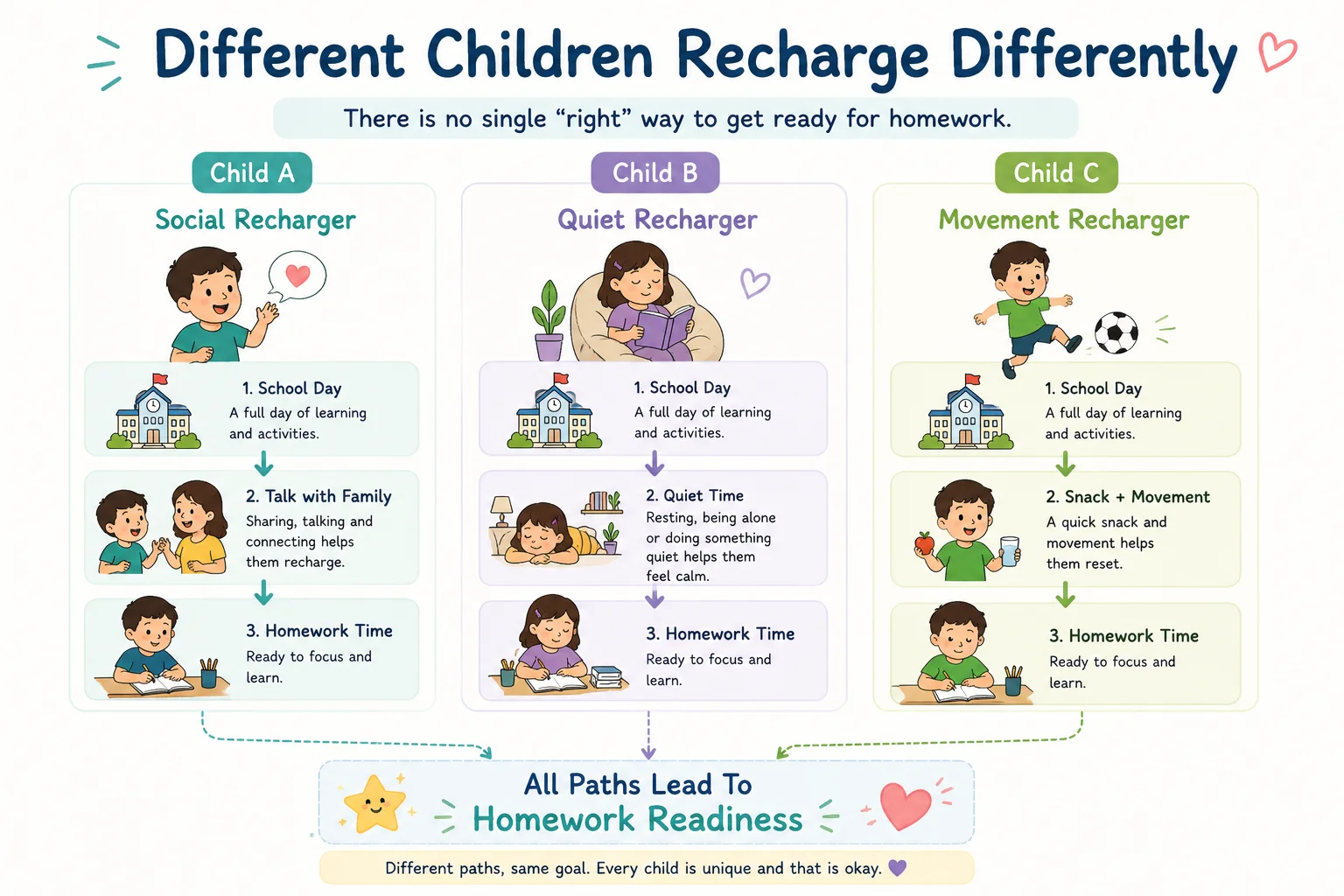
This diagram can show three simple paths:
- Child A: School → Talk with family → Homework
- Child B: School → Quiet time → Homework
- Child C: School → Snack and movement → Homework
All three paths can lead to homework readiness. The message is simple: there is not only one correct way for a child to prepare for learning at home.
Practical Insights for Busy Families
Every family will need a different rhythm, but some gentle patterns can make homework time feel calmer.
- Some children focus better after a short quiet pause.
- Some children need a few minutes where nobody asks them questions. The quiet itself can be part of the recovery.
- A snack or drink may help before homework begins.
- Quiet time can be short and simple, not a full routine.
- A calm start can sometimes prevent a bigger argument later.
- The first task may feel easier when it is small and clear.
These are not strict rules. They are gentle observations that families can adjust depending on the child, the day, and the home environment.
Common Misunderstandings
Needing quiet before homework can be misunderstood, especially when parents are tired or worried about school progress.
- Quiet does not always mean sadness.
- Resting does not always mean laziness.
- Delayed starting does not always mean defiance.
- Needing space does not mean a child dislikes family.
- Slow transitions do not mean poor learning ability.
- A quiet child may still care deeply about doing well.
When parents understand the need behind the behavior, it becomes easier to respond with calm instead of pressure.
During Busy School Periods
The need for quiet before homework time may become stronger during busy school periods. This can happen near tests, after long school events, during sports seasons, or at the end of a tiring school term.
A child who usually starts homework easily may suddenly need more time to settle. This does not always mean something has gone wrong. It may simply mean their emotional and mental energy is lower than usual.
Busy school periods are not only about tests. Sports carnivals, school concerts, class presentations, excursions, friendship changes, or group projects can all use emotional energy. A child may enjoy these events and still come home needing quiet before homework time.
During these times, a smaller homework start can help. One easy question, one short reading page, or one small review task may feel more possible than a full homework session.
Jolyti Note: I’ve noticed that some children seem more ready to learn after they have had a few quiet moments to settle. In many homes, confidence grows quietly when children feel understood instead of rushed. Every child is different, and those differences often become clearer after a busy school day.
Frequently Asked Questions
Does needing quiet before homework mean my child is overwhelmed?
Not always. Some children simply need quiet to move from school mode into home mode. If the child becomes calmer and more ready after a short pause, it may be a normal recovery pattern.
How long should quiet time be before homework?
There is no perfect number. Some children may only need a few minutes, while others may need longer after a tiring day. The goal is not a strict time limit, but a calmer start.
What if quiet time turns into long homework delay?
If quiet time keeps turning into long avoidance, the child may need a smaller first task, clearer instructions, or support with the part that feels difficult. The delay may be connected to worry, confusion, or tiredness.
Why does my child need quiet some days but not others?
Children’s energy changes from day to day. A harder lesson, friendship problem, poor sleep, school event, or busy classroom day can all affect how much recovery time they need after school.
Should homework always start after quiet time?
Not for every child. Some children prefer to start quickly and finish early. Others do better with a calm pause first. The best pattern is usually the one that helps the child begin without feeling defeated.
Final Thoughts
Why some children need quiet before homework time is often connected to how they recover from the school day. Their need for quiet may be a sign of mental tiredness, emotional processing, or a slower transition from school to home.
This does not mean the child is weak, lazy, or unwilling to learn. Many children care about learning but need a calm space before they can show it.
In real families, homework confidence often grows through small, safe moments. A short quiet pause, a gentle start, and a little understanding can help some children return to learning with less pressure and more confidence.
Featured image is AI-generated and intended for illustrative purposes only.
Leave a Reply