
Homework can begin with a simple question and somehow become a full argument. A child may refuse to start, complain, cry, shut down, or answer back. A parent may feel tired, worried, or frustrated after repeating the same reminder many times.
How to stop homework from turning into arguments often starts with making the homework moment feel calmer, smaller, and safer. Many children cooperate better when they feel understood first, instead of feeling pushed, judged, or rushed.
This can be hard in real homes. Parents may be cooking dinner, answering messages, helping other children, or coming home tired from work. Children may also be tired after school, hungry, emotional, overstimulated, or worried about making mistakes.
This article will explain how to stop homework from turning into arguments in a calm, realistic, and confidence-building way. The goal is not to create a perfect homework routine. The goal is to make learning at home feel less like a fight and more like something your child can face with support.
Why Homework Arguments Happen in Real Homes
In many homes, homework does not happen in a quiet room with calm music and unlimited time. It often happens while dinner is being made, siblings are talking, devices are nearby, and everyone is already tired.
A child may come home after using focus all day at school. They may have listened, followed instructions, managed friendships, dealt with noise, and tried to keep up in class. By the time homework starts, their mind may already feel full.
Parents may also be carrying a lot. A homework argument can feel like one more problem at the end of a long day. Even loving parents can sound sharper than they mean to when they are tired or worried.
So when homework turns into arguments, it does not always mean the child is lazy or the parent is doing something wrong. It often means the homework moment is carrying too much pressure for both sides.
Why Traditional Homework Advice Sometimes Fails
Common homework advice often says to make a routine, remove distractions, and stay consistent. These ideas can help, but they do not solve every homework battle.
Some children do not resist homework because they do not care. They resist because the work feels too big, too hard, too boring, too embarrassing, or too connected to past arguments.
If a child already expects homework to end in correction or conflict, they may become defensive before they even begin. This is why pressure can sometimes make homework resistance stronger.
For some families, it also helps to understand why learning at home can feel harder than school. You may find Why Homework Feels Harder at Home Than at School helpful as a related read.
Why Homework Turns Into Arguments
Homework arguments often follow a pattern. The child feels stressed or overwhelmed. The parent notices resistance and pushes harder. The child feels more pressured. Then the argument grows.
This can happen even when both people want the same thing. The parent wants the homework done. The child wants the difficult feeling to stop.
When the focus becomes winning the argument, learning usually disappears. The child may complete less work, feel less confident, and become more resistant the next time homework begins.
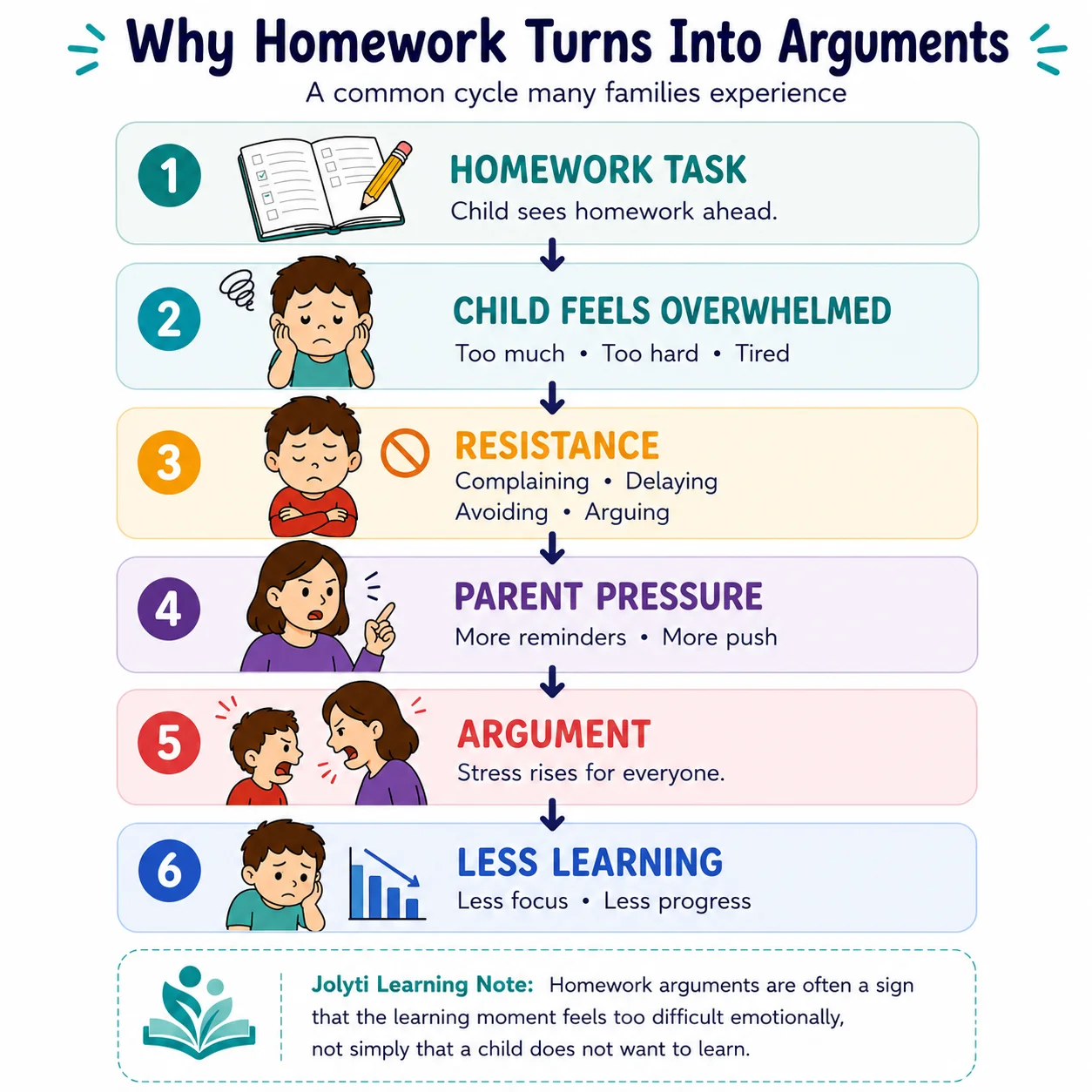
This visual can help parents see that homework conflict is often a cycle. When the cycle is understood, it becomes easier to interrupt it calmly.
Make Homework Feel Like a Shared Problem
One helpful shift is to stop treating homework resistance as a battle between parent and child.
Instead, try treating the homework problem as something you and your child are looking at together. This does not mean removing responsibility from the child. It means making them feel less alone with the struggle.
For example, instead of saying, “Why are you making this so hard?” you might say, “This homework feels hard to start today. Let’s look at the first part together.”
That small change can lower defensiveness. Children often become more open to help when they feel someone is beside them, not standing over them.
Focus on Starting, Not Finishing
Parents usually think about finishing homework. Children often get stuck before they even start.
To a child, the whole worksheet, reading task, or writing activity may look too big. If they already feel tired or unsure, the full task can feel impossible.
In that moment, the first step matters more than the full assignment.
- Open the book.
- Read the first instruction.
- Answer one question.
- Write the first sentence.
- Underline the words they understand.
Once a child starts, the task often feels less threatening. Starting creates movement, and movement can reduce arguing.
The Small Steps Homework Method
When parents want to stop homework from turning into arguments, one of the most useful ideas is to make the task smaller before emotions get bigger.
This does not mean avoiding homework. It means making homework feel possible enough for the child to begin.
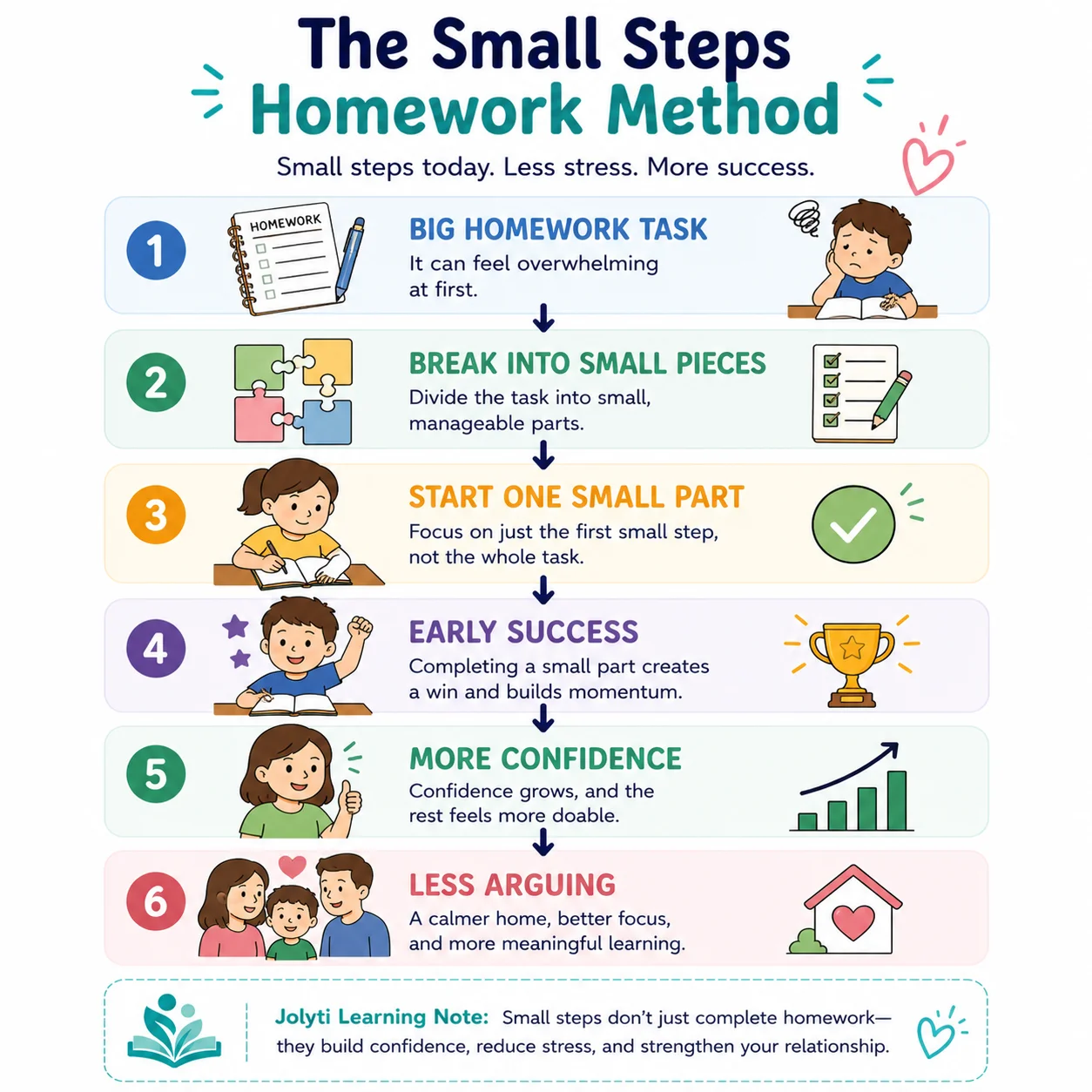
The simple flow is: big homework task, smaller pieces, one small start, early success, more confidence, and less arguing.
This connects closely with Why Short Study Sessions Work Better for Some Children, especially for children who lose focus or confidence during long homework sessions.
What Children Need Before They Can Focus
Sometimes children are told to “just focus,” but focus is not always something they can switch on quickly.
Before some children can focus, they may need calm, food, movement, reassurance, or a clearer first step. If those needs are ignored, homework can become a fight before learning has a chance to begin.
| What the Child May Need | What It Can Look Like at Home |
|---|---|
| Calm | A few quiet minutes before starting homework |
| Energy | A snack, water, or short break after school |
| Safety | Knowing mistakes will not lead to shame or anger |
| Clarity | One small first step instead of the whole task |
| Support | A parent nearby at the beginning, not hovering the whole time |
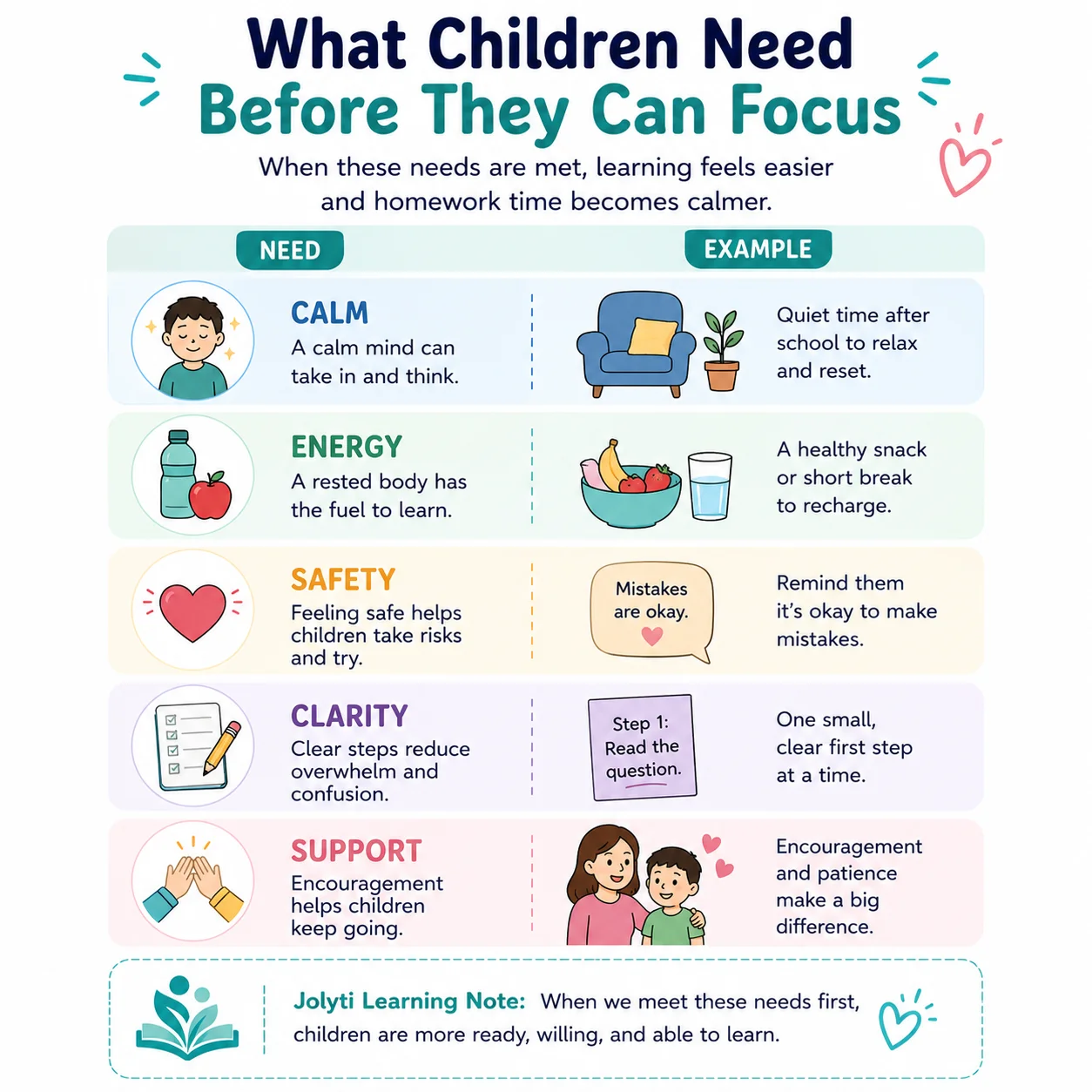
This visual can help parents remember that focus often grows from readiness, not pressure.
Look for Hidden Fear Behind Resistance
Some homework arguments are not really about homework. They are about fear.
A child may be afraid of getting answers wrong. They may worry that parents will be disappointed. They may feel embarrassed because the work seems easy for others but hard for them.
Fear does not always look like fear. In children, it may look like:
- arguing
- joking around
- avoiding the task
- saying “I don’t care”
- getting angry quickly
- refusing help
If this pattern sounds familiar, Signs a Child Is Afraid of Getting Answers Wrong may help you understand what could be happening underneath the resistance.
Use Calming Words During Homework
The words used during homework can either increase tension or reduce it.
This does not mean parents need perfect words every time. It simply means that calmer words can help the child stay connected to the task instead of preparing for a fight.
| When Tension Builds | When Tension Calms |
|---|---|
| “Why haven’t you started yet?” | “What is making it hard to begin?” |
| “You need to finish this now.” | “Let’s start with one small part.” |
| “You know this already.” | “It is okay to need help sometimes.” |
| “Stop complaining.” | “This seems frustrating today.” |
| “Just focus.” | “What would help you focus better?” |
These phrases do not remove limits or expectations. They simply make the homework conversation safer, which can make cooperation easier.
Practical Ideas for Busy Families
Reducing homework arguments does not need to become a big parenting project. Small changes can make homework feel calmer over time.
- Give your child a short transition after school before starting homework.
- Start with the easiest part to build momentum.
- Use short homework blocks when emotions are high.
- Sit nearby for the first few minutes, then give space.
- Notice effort before pointing out mistakes.
- Take a short break before the conversation becomes heated.
- Keep correction calm and brief.
- End by noticing one thing your child did well.
These ideas are not strict rules. They are small ways to protect the learning relationship while still helping homework get done.
Common Mistakes That Can Make Homework Arguments Worse
Most parents do some of these things when they are tired or worried. This is not about guilt. It is simply helpful to notice what may make homework feel more stressful for a child.
- Correcting every mistake immediately.
- Turning homework into a long lecture.
- Comparing the child with siblings or classmates.
- Assuming resistance always means laziness.
- Continuing the homework conversation after emotions have become too high.
- Praising only perfect answers instead of effort and progress.
When homework feels emotionally safer, many children become more willing to try.
Different Children Need Different Homework Support
Some children need closeness at the beginning of homework. Others need space. Some need to talk before starting. Others need quiet. Some need movement before they can sit. Others need reassurance that mistakes are allowed.
A quiet child may shut down without saying much. A sensitive child may cry quickly when corrected. An energetic child may look distracted when they are actually trying to manage discomfort. An independent child may refuse help because help feels embarrassing.
This is why one homework strategy will not fit every child.
The aim is not to control every detail. The aim is to notice what helps your child feel steady enough to try.
Homework During Busy Family Seasons
Homework arguments may become stronger during busy parts of the school year. Assessment weeks, school-term tiredness, family stress, illness, sports, and routine changes can all affect a child’s patience and focus.
During these seasons, it can help to lower the emotional pressure around homework while still keeping gentle expectations.
A shorter, calmer homework session is often more useful than a long session filled with conflict.
Jolyti Note: I’ve noticed that homework arguments often become smaller when the first step becomes smaller too. Many children seem more willing to try when they feel someone is helping them begin, not judging how long it took to start.
Frequently Asked Questions
How do I stop homework from turning into arguments?
Start by lowering pressure and making the first step smaller. Many children respond better when they feel understood before they are corrected or pushed to finish.
Why does my child argue every time homework starts?
Daily homework arguments may come from tiredness, overwhelm, fear of mistakes, confusion, or past homework stress. The argument may be a sign that the task feels emotionally too big.
Should I make my child finish homework even if they are upset?
Homework matters, but learning usually works better when the child is calm enough to think. A short break, smaller task, or calmer restart may help more than forcing the moment.
What should I say when my child refuses homework?
You might say, “This feels hard to start today. Let’s choose one small part first.” This keeps the expectation while reducing the emotional pressure.
When should I talk to the teacher about homework stress?
If homework arguments happen often, affect your child’s confidence, or create stress most nights, it may help to speak with the teacher. The teacher may be able to adjust expectations or explain what support is needed.
Final Thoughts
Learning how to stop homework from turning into arguments is not about becoming a perfect parent or creating a perfect routine. It is about making homework feel safer, smaller, and more possible.
Children often argue less when they feel understood, supported, and capable of taking one small step. Parents often feel calmer when homework is no longer treated like a nightly battle that must be won.
Some evenings will still be difficult. That is normal. But small calm changes can slowly protect your child’s confidence and make learning at home feel less overwhelming for everyone.
Featured image is AI-generated and intended for illustrative purposes only.
Leave a Reply